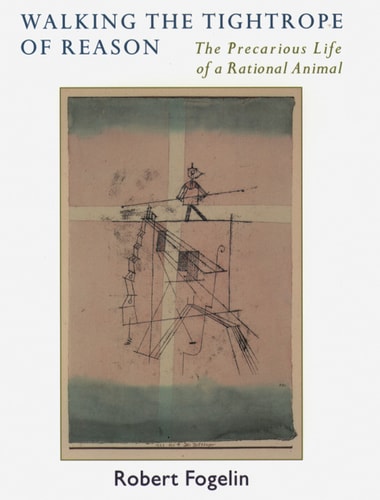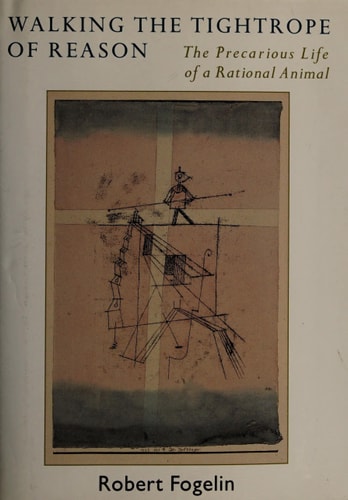
Walking the Tightrope of Reason
0
0
As an Amazon Associate and affiliate partner, Menrva Books earns from qualifying purchases. Learn more
Author Description
Human beings are both supremely rational and deeply superstitious, capable of believing just about anything and of questioning just about everything. Indeed, just as our reason demands that we know the truth, our skepticism leads to doubts we can ever really do so.In Walking the Tightrope of Reason, Robert J. Fogelin guides readers through a contradiction that lies at the very heart of philosophical inquiry. Fogelin argues that our rational faculties insist on a purely rational account of the universe, yet at the same time, the inherent limitations of these faculties ensure that we will never fully satisfy that demand. As a result of being driven to this point of paradox, we either comfort ourselves with what Kant called "metaphysical illusions" or adopt a stance of radical skepticism. No middle ground seems possible and, as Fogelin shows, skepticism, even though a healthy dose of it is essential for living a rational life, "has an inherent tendency to become unlimited in its scope, with the result that the edifice of rationality is destroyed." In much Postmodernist thought, for example, skepticism takes the extreme form of absolute relativism, denying the basis for any value distinctions and treating all truth-claims as equally groundless. How reason avoids disgracing itself, walking a fine line between dogmatic belief and self-defeating doubt, is the question Fogelin seeks to answer.Reflecting upon the ancient Greek skeptics as well as such thinkers as Hume, Kant, Wittgenstein, Nietzsche, and Whitman, this book takes readers into--and through--some of philosophy's most troubling paradoxes.
Menrva's Summary
THE THESIS
How can human beings maintain a rational existence while navigating the inherent tension between the desire for objective truth and the limitations of human skepticism? Robert J. Fogelin, a noted philosopher, examines the paradox where our rational faculties demand a complete account of the universe while simultaneously proving incapable of providing one. By analyzing the historical trajectory of philosophical thought, Fogelin argues that we must find a precarious balance to avoid the extremes of dogmatic belief or self-defeating radical skepticism.
THE SCOPE MAP
What You Will Find
- An analysis of the philosophical conflict between rationalism and skepticism.
- A critical review of thinkers including Hume, Kant, Wittgenstein, Nietzsche, and Whitman.
- An examination of the dangers of absolute relativism and postmodernist thought.
- A framework for maintaining a moderate, functional skepticism in daily life.
THE AUTHORITY PERSPECTIVE
Experts recognize this work as a clear and accessible entry point into complex epistemological debates regarding the limits of human reason. Readers frequently note that Fogelin successfully distills dense philosophical paradoxes into a coherent argument that remains relevant to contemporary discourse on truth and belief.
Page Count:
224
Publication Date:
2003-07-17
Publisher:
Oxford University Press
ISBN-10:
0195160266
ISBN-13:
9780195160260
Non-Fiction
Philosophy
Epistemology
Skepticism
Reason
Community Tags
Similar Books