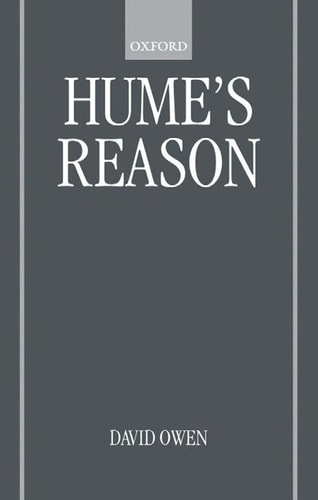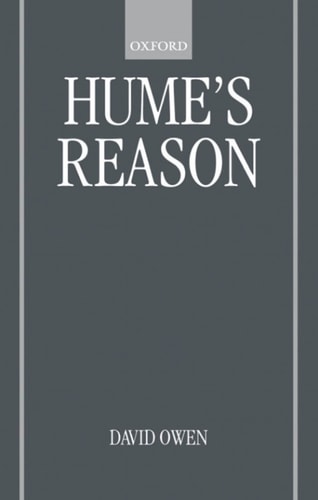
Hume's Reason
0
0
As an Amazon Associate and affiliate partner, Menrva Books earns from qualifying purchases. Learn more
Author Description
David Owen explores Hume's account of reason and its role in human understanding, seen in the context of other notable accounts by philosophers of the early modern period. Many of the most famous problems that Hume discusses, and many of the positions that he advocates, are expressed in terms of reason. It is central to his arguments about induction, belief, scepticism, the passions, and moral distinctions; to understand Hume's influential views on these matters, we must understand what his view of reason is. The book begins with chapters on the theories of reasoning put forward by Hume's notable predecessors Descartes and Locke. Owen shows that Hume followed them in rejecting a formal, deductive account of inference, in favour of a new naturalistic account. But he went farther, in what we now call the argument concerning induction, by showing that no account of reason as a separate faculty could explain our inferences to beliefs in the unobserved. Hume offers instead an associationist account of probable reasoning and a new theory of belief. The picture of reason as an independent faculty is replaced with an explanation of reasoning in terms of properties of the imagination. Hume's Reason offers a new interpretation of some of Hume's central ideas, and a treatment of reason which will be illuminating not just to historians of modern philosophy but to all philosophers who are concerned with the workings of human cognition.
Menrva's Summary
THE THESIS
This book investigates the specific definition and function of reason within David Hume's philosophical framework and its departure from early modern predecessors. David Owen, a scholar of early modern philosophy, utilizes Hume's primary texts to contrast his naturalistic approach with the rationalist and empiricist traditions of Descartes and Locke. The author argues that Hume effectively dismantled the concept of reason as an independent faculty, replacing it with an associationist model rooted in the imagination.
THE SCOPE MAP
What You Will Find
- Comparative analysis of reasoning theories by Descartes, Locke, and Hume
- Examination of the argument concerning induction and its implications for human belief
- Exploration of the relationship between reason, passions, and moral distinctions
Scope Limits
- Does not provide a comprehensive biography of David Hume
- Does not address Hume's political or economic writings in significant detail
THE AUTHORITY PERSPECTIVE
Experts identify this work as a rigorous contribution to Humean scholarship that clarifies the mechanics of his naturalistic epistemology. Readers frequently note the academic density of the prose, which is primarily intended for students and scholars of philosophy.
Page Count:
248
Publication Date:
1999-01-01
Publisher:
OUP Oxford
ISBN-10:
0191519391
ISBN-13:
9780191519390
Philosophy
Reason
History & Surveys
Early Modern
Epistemology
Philosophy history