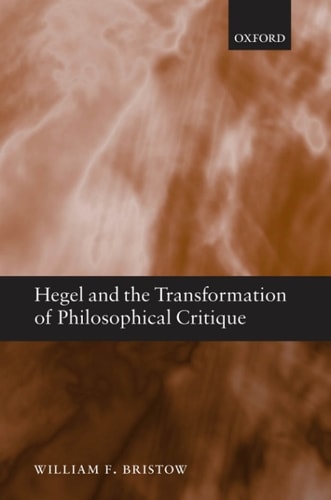
Hegel and the Transformation of Philosophical Critique
0
0
As an Amazon Associate and affiliate partner, Menrva Books earns from qualifying purchases. Learn more
Author Description
William F. Bristow presents an original and illuminating study of Hegel's hugely influential but notoriously difficult Phenomenology of Spirit. Hegel describes the method of this work as a 'way of despair', meaning thereby that the reader who undertakes its inquiry must be open to the experience of self-loss through it. Whereas the existential dimension of Hegel's work has often been either ignored or regarded as romantic ornamentation, Bristow argues that it belongs centrally to Hegel's attempt to fulfil a demanding epistemological ambition. With his Critique of Pure Reason, Kant expressed a new epistemological demand with respect to rational knowledge and presented a new method for meeting this demand. Bristow reconstructs Hegel's objection to Kant's Critical Philosophy, according to which Kant's way of meeting the epistemological demand of philosophical critique presupposes subjectivism, that is, presupposes the restriction of our knowledge to things as they are merely for us. Whereas Hegel in his early Jena writings rejects Kant's critical project altogether on this basis, he comes to see that the epistemological demand expressed in Kant's project must be met. Bristow argues that Hegel's method in the Phenomenology of Spirit takes shape as his attempt to meet the epistemological demand of Kantian critique without presupposing subjectivism. The key to Hegel's transformation of Kant's critical procedure, by virtue of which subjectivism is to be avoided, is precisely the existential or self-transformational dimension of Hegel's criticism, the openness of the criticizing subject to being transformed through the epistemological procedure.
Menrva's Summary
THE THESIS
This work investigates how Hegel transforms the Kantian project of philosophical critique to meet epistemological demands without relying on subjectivist presuppositions. William F. Bristow, a scholar of German Idealism, examines the methodological structure of Hegel's Phenomenology of Spirit. He argues that the existential dimension of the text—often dismissed as mere ornamentation—is actually a rigorous epistemological tool. By analyzing the transition from Kant's critical philosophy to Hegel's dialectical method, Bristow demonstrates how the subject's self-transformation serves as the mechanism for achieving objective knowledge.
THE SCOPE MAP
What You Will Find
- A detailed reconstruction of Hegel's critique of Kantian subjectivism.
- An analysis of the 'way of despair' as a formal epistemological method.
- A comparative study of early Jena writings versus the Phenomenology of Spirit.
Scope Limits
- The text does not provide a general introduction to Hegel's entire body of work.
- It does not focus on Hegel's political or social philosophy outside of the epistemological framework.
THE AUTHORITY PERSPECTIVE
Scholars frequently note the high level of academic density in Bristow's prose, which requires a strong background in Kantian terminology. Experts highlight this as a significant contribution to the study of Hegel's methodology, particularly for those interested in the intersection of existential experience and formal epistemology.
Page Count:
272
Publication Date:
2007-01-01
Publisher:
Clarendon Press
ISBN-10:
0191537411
ISBN-13:
9780191537417
Philosophy
Reason
Academic
History & Surveys
Metaphysics
Epistemology
Community Tags
Other Editions(4)


Similar Books


Reader Comments
Share Your Thoughts
No comments yet. Be the first to share your thoughts!