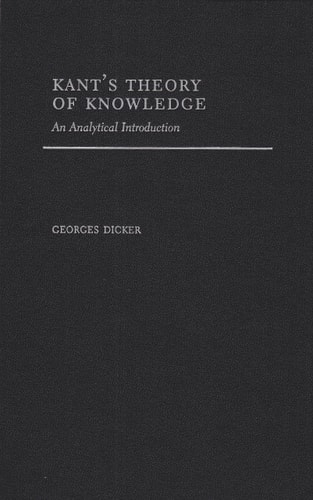
Kant's Theory of Knowledge: An Analytical Introduction
0
0
As an Amazon Associate and affiliate partner, Menrva Books earns from qualifying purchases. Learn more
Author Description
The Critique of Pure Reason is Kant's acknowledged masterpiece, in which he tackles the question of how we can possibly have knowledge that does not rest on experience (a priori knowledge). The first half of the Critique advances a constructive theory of human cognition and defends the possibility of human knowledge against the skeptical empiricism of Hume. These sections of the Critique are difficult for beginners and for advanced students alike. While there exist many scholarly works discussing the Critique on an advanced level, this book is explicitly designed to be read alongside the text by first-time readers of Kant. Dicker makes Kant's views and arguments as accessible as possible without oversimplifying them, and synthesizes the views of contemporary scholars. Kant's Theory of Knowledge will be useful to both undergraduate and graduate students struggling with this notoriously difficult yet deeply influential thinker.
Menrva's Summary
THE THESIS
This book investigates the core question of how human beings can possess a priori knowledge that does not rely on sensory experience. Georges Dicker, a scholar specializing in modern philosophy, provides a structured analysis of Immanuel Kant's Critique of Pure Reason. He utilizes a pedagogical framework designed to guide readers through Kant's complex arguments, specifically addressing the tension between rationalism and the skeptical empiricism of David Hume.
THE SCOPE MAP
What You Will Find
- A detailed examination of the first half of the Critique of Pure Reason
- Analysis of Kant's constructive theory of human cognition
- Synthesis of contemporary scholarly interpretations of Kantian thought
Scope Limits
- Does not provide a comprehensive analysis of the entire Critique of Pure Reason
- Does not focus on Kant's moral or aesthetic philosophy
THE AUTHORITY PERSPECTIVE
Experts and educators frequently cite this work as a highly effective companion text for students encountering Kant for the first time. Readers often note that the prose maintains academic rigor while successfully clarifying notoriously dense philosophical arguments.
Page Count:
280
Publication Date:
2004-01-01
Publisher:
Oxford University Press
ISBN-10:
0190288353
ISBN-13:
9780190288358
Philosophy
Non-Fiction
Academic
Knowledge Theory
Epistemology
Reason
Causation
History & Surveys
Metaphysics