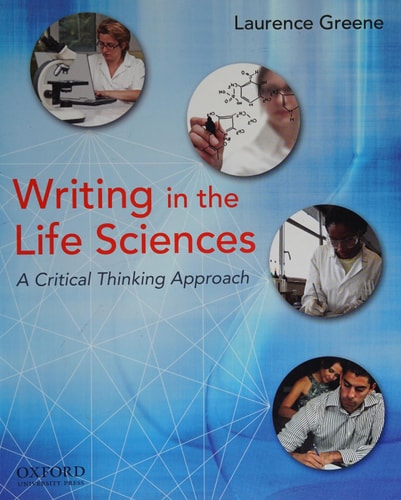
Writing in the Life Sciences: A Critical Thinking Approach
0
0
As an Amazon Associate and affiliate partner, Menrva Books earns from qualifying purchases. Learn more
Author Description
Practicing scientists know that the quality of their livelihood is strongly connected to the quality of their writing, and critical thinking is the most necessary and valuable tool for effectively generating and communicating scientific information. Writing in the Life Sciences is an innovative, process-based text that gives beginning writers the tools to write about science skillfully by taking a critical thinking approach. Laurence Greene emphasizes "writing as thinking" as he takes beginning writers through the important stages of planning, drafting, and revising their work. Throughout, he uses focused and systematic critical reading and thinking activities to help scientific writers develop the skills to effectively communicate. Each chapter addresses a particular writing task rather than a specific type of document. The book makes clear which tasks are important for all writing projects (i.e., audience analysis, attending to instructions) and which are unique to a specific writing project (rhetorical goals for each type of document). Ideal for Scientific Writing courses and writing-intensive courses in various science departments (e.g., Biology, Environmental Studies, etc.), this innovative, process-based text goes beyond explaining what scientific writing is and gives students the tools to do it skillfully.
Menrva's Summary
THE THESIS
This book investigates the fundamental link between critical thinking and effective communication within the scientific community. Laurence Greene, an expert in academic composition, argues that scientific writing is not merely a technical skill but a cognitive process that requires rigorous planning, drafting, and revision. By framing writing as a form of thinking, the text provides a systematic methodology for students and researchers to translate complex data into clear, persuasive prose.
THE SCOPE MAP
What You Will Find
- A process-based framework for planning, drafting, and revising scientific documents.
- Systematic critical reading and thinking exercises designed to improve analytical clarity.
- Guidance on audience analysis and adherence to specific project instructions.
- Strategies for identifying rhetorical goals across various types of scientific writing tasks.
THE AUTHORITY PERSPECTIVE
Educators frequently utilize this text as a foundational resource for writing-intensive courses in biology and environmental studies. The consensus among academic reviewers is that the book successfully bridges the gap between theoretical composition and practical scientific application.
Page Count:
512
Publication Date:
2010-01-13
Publisher:
Oxford University Press
ISBN-10:
0195170466
ISBN-13:
9780195170467
Science
Education
Academic writing
Reference
Biology
Communication
Community Tags
Similar Books