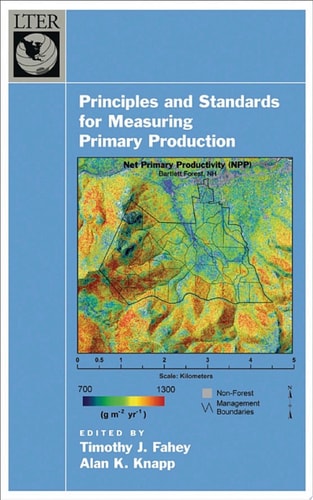
Principles and Standards for Measuring Primary Production
0
0
As an Amazon Associate and affiliate partner, Menrva Books earns from qualifying purchases. Learn more
Author Description
Principles and Standards for Measuring Net Primary Production in Long-Term Ecological Studies is the first book to establish a standardized method for measuring net primary productivity (NPP) in ecological research. Primary productivity is the rate at which energy is stored in the organic matter of plants per unit area of the earth's surface. As the beginning stage of the carbon cycle, our ability to accurately measure NPP is essential to any ecological analysis, as well as agronomy, forestry, fisheries, limnology and oceanography. In fact, NPP measurements are fundamental to ecosystem studies at thousands of sites around the world.All 26 LTER sites will be expected to collect and report data using these new standards, but the standards should reach well beyond LTER sites. Identified standards for NPP measurements will allow researchers from diverse biomes to authoritatively compare measurements among their sites. Comparable measurements will build a foundation for a broad scale understanding of the environmental, biological, and nutrition controls on NPP.The book includes chapters for each of the critical biome types, including special techniques that work best in each environment. For example, there are chapters that discuss grassland ecosystems, urban ecosystems, marine pelagic ecosystems, forest ecosystems, and salt marsh ecosystems, among others.
Menrva's Summary
THE THESIS
This book establishes a unified, standardized methodology for measuring net primary productivity (NPP) across diverse ecological research sites. Editors Alan K. Knapp and Timothy J. Fahey, drawing on the collaborative expertise of the Long-Term Ecological Research (LTER) network, provide a rigorous framework for quantifying energy storage in plant organic matter. The text argues that standardized data collection is a prerequisite for cross-biome comparisons and a deeper understanding of global carbon cycle dynamics.
THE SCOPE MAP
What You Will Find
- Standardized protocols for measuring NPP in various biomes.
- Comparative analysis techniques for grassland, forest, urban, marine, and salt marsh ecosystems.
- Methodological guidelines for integrating site-specific data into broader ecological models.
Scope Limits
- The text focuses primarily on established LTER-compatible methodologies rather than experimental or unproven techniques.
- It does not provide exhaustive coverage of every minor micro-habitat variation found globally.
THE AUTHORITY PERSPECTIVE
Experts recognize this volume as the foundational reference for researchers aiming to align their data collection with international ecological standards. Readers frequently note the technical density of the prose, which is intended for professional ecologists and advanced students in the field.
Page Count:
272
Publication Date:
2007-01-01
Publisher:
Oxford University Press
ISBN-10:
0190290692
ISBN-13:
9780190290696
Science
Ecology
Biology
Botany
Community Tags
Other Editions(3)


Similar Books