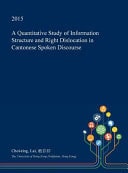
A Quantitative Study of Information Structure and Right Dislocation in Cantonese Spoken Discourse
0
0
As an Amazon Associate and affiliate partner, Menrva Books earns from qualifying purchases. Learn more
Author Description
This dissertation, "A Quantitative Study of Information Structure and Right Dislocation in Cantonese Spoken Discourse" by Choi-ting, Lai,, was obtained from The University of Hong Kong (Pokfulam, Hong Kong) and is being sold pursuant to Creative Commons: Attribution 3.0 Hong Kong License. The content of this dissertation has not been altered in any way. We have altered the formatting in order to facilitate the ease of printing and reading of the dissertation. All rights not granted by the above license are retained by the author. Abstract: This study investigated information structure in spoken Cantonese and the use of right dislocation (RD) in genres with different degrees of shared knowledge and planning time pressure. Previous studies based on written data have suggested that Chinese word order is greatly determined by information structure. The pre-verbal referent in a sentence is reserved for background or topical information; while focus information is expressed in the post-verbal or right-most position in a sentence. The preferred argument structure (PAS) account has proposed a pattern of information flow in spoken discourse. New referents are free to appear pre-verbally in intransitive clauses, but rarely found in the subject of transitive clauses. However, it has also been suggested that RD is a focus marking device motivated by limited planning time in conversation. In RD structures, less important information is dislocated to the end of a sentence. The data of the present study were extracted from a recently developed corpus of oral narratives in Cantonese Chinese based on approximately 8 hours of recordings. The corpus consisted of speech samples from 144 native Cantonese speakers evenly distributed in three age groups, two education levels and gender. Three genres representing different degrees of shared knowledge and planning time pressure were chosen for analysis: procedural description, story-telling and recount of personal event. A tota
Menrva's Summary
THE THESIS
This study investigates how information is structured in spoken Cantonese and the role of right dislocation (RD) in discourse genres with varying levels of shared knowledge and planning time. The research examines the hypothesis that Chinese word order is heavily influenced by information structure, with background information preceding focus information. It also explores the theory that RD, where less important information is moved to the end of a sentence, is a strategy employed under the pressure of limited planning time in spontaneous conversation. The study utilizes a corpus of oral Cantonese narratives from 144 native speakers across different age groups, education levels, and genders, analyzing three distinct genres: procedural description, story-telling, and personal event recounting.
THE SCOPE MAP
- Analysis of information structure in spoken Cantonese.
- Investigation into the function of right dislocation (RD) in discourse.
- Examination of genres with differing degrees of shared knowledge and planning time.
- Comparison of findings with previous studies based on written data.
- Application of the Preferred Argument Structure (PAS) account to spoken discourse.
- Data extracted from a corpus of approximately 8 hours of oral Cantonese narratives.
- Inclusion of speech samples from 144 native Cantonese speakers.
- Analysis across three genres: procedural description, story-telling, and personal event recounting.
THE AUTHORITY PERSPECTIVE
This dissertation presents a quantitative analysis of information structure and right dislocation in spoken Cantonese, drawing on a substantial corpus of oral narratives. The research contributes to the understanding of how syntactic structures in Chinese are shaped by discourse-level information packaging and the cognitive constraints of spontaneous speech. The study's methodology, which includes a diverse participant base and genre variation, offers a robust framework for examining linguistic phenomena in real-time communication. The findings are expected to inform theories on information flow and syntactic motivation in discourse.
Page Count:
0
Publication Date:
2017-01-26
Publisher:
BiblioBazaar
ISBN-10:
1361012080
ISBN-13:
9781361012086
Non-Fiction
Science
Information Structure
Discourse Analysis
Linguistics
Syntax
Cantonese
Community Tags
Similar Books


Reader Comments
Share Your Thoughts
No comments yet. Be the first to share your thoughts!