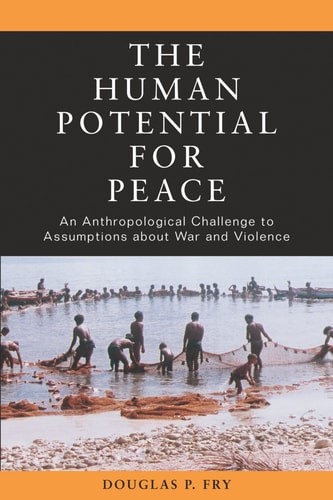
The Human Potential for Peace: An Anthropological Challenge to Assumptions about War and Violence
0
0
As an Amazon Associate and affiliate partner, Menrva Books earns from qualifying purchases. Learn more
Author Description
In The Human Potential for Peace: An Anthropological Challenge to Assumptions about War and Violence, renowned anthropologist Douglas P. Fry shows how anthropology--with its expansive time frame and comparative orientation--can provide unique insights into the nature of war and the potential for peace. Challenging the traditional view that humans are by nature primarily violent and warlike, Professor Fry argues that along with the capacity for aggression humans also possess a strong ability to prevent, limit, and resolve conflicts without violence. Raising philosophy of science issues, the author shows that cultural beliefs asserting the inevitability of violence and war can bias our interpretations, affect our views of ourselves, and may even blind us to the possibility of achieving security without war. Fry draws on data from cultural anthropology, archaeology, and sociology as well as from behavioral ecology and evolutionary biology to construct a biosocial argument that challenges a host of commonly held assumptions.The Human Potential for Peace includes ethnographic examples from around the globe, findings from Fry's research among the Zapotec of Mexico, and results of cross-cultural studies on warfare. In showing that conflict resolution exists across cultures and by documenting the existence of numerous peaceful societies, it demonstrates that dealing with conflict without violence is not merely a utopian dream. The book also explores several highly publicized and interesting controversies, including Freeman's critique of Margaret Mead's writings on Samoan warfare; Napoleon Chagnon's claims about the Yanomamö; and ongoing evolutionary debates about whether "hunter-gatherers" are peaceful or warlike. The Human Potential for Peace is ideal for undergraduate courses in political and legal anthropology, the anthropology of peace and conflict, peace studies, political sociology, and the sociology of war and violence. Written in an informal style with numerous ente
Menrva's Summary
THE THESIS
Does the human capacity for aggression necessitate a biological or evolutionary predisposition toward war and violence? Douglas P. Fry, a distinguished anthropologist, utilizes a multidisciplinary framework to dismantle the assumption that human conflict is inherently destructive. By synthesizing data from archaeology, behavioral ecology, and cross-cultural ethnography, Fry argues that humans possess an equally robust, innate capacity for conflict resolution and peaceful coexistence.
THE SCOPE MAP
What You Will Find
- Comparative analysis of peaceful societies versus warlike cultures across global ethnographic records.
- Critical evaluation of evolutionary debates regarding hunter-gatherer social structures.
- Examination of academic controversies, including the critiques of Margaret Mead and Napoleon Chagnon.
- Synthesis of biosocial evidence demonstrating that non-violent conflict resolution is a documented human practice.
THE AUTHORITY PERSPECTIVE
Experts recognize this work as a significant contribution to the anthropology of peace and conflict, often citing its utility in undergraduate curricula for its accessible, informal prose. Readers frequently note that the text provides a necessary counter-narrative to biological determinism, making it a foundational resource for those studying the sociology of violence.
Page Count:
384
Publication Date:
2005-07-28
Publisher:
Oxford University Press
ISBN-10:
0195181786
ISBN-13:
9780195181784
Non-Fiction
Conflict Resolution
Anthropology
Violence
Evolutionary Biology
Peace studies
Social Control
Sociology
Intergroup Relations
Community Tags
Other Editions(2)
Similar Books

Reader Comments
Share Your Thoughts
No comments yet. Be the first to share your thoughts!