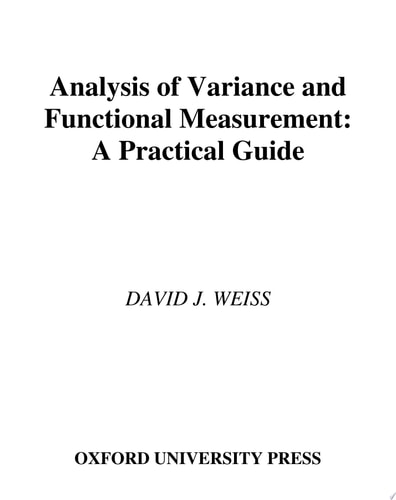
Analysis of Variance and Functional Measurement: A Practical Guide
0
0
As an Amazon Associate and affiliate partner, Menrva Books earns from qualifying purchases. Learn more
Author Description
This book is a clear and straightforward guide to analysis of variance, the backbone of experimental research. It will show you how to interpret statistical results and translate them into prose that will clearly tell your audience what your data is saying. To help you become familiar with the techniques used in analysis of variance, there are plenty of end-of-chapter practice problems with suggested answers. As life in the laboratory doesnt always follow a script, there are both new and established techniques for coping with situations that deviate from the norm. Data analysis is not a closed subject, so there are pros and cons for the varied situations you will encounter. The final chapter gives the first elementary presentation of functional measurement, or information integration theory, a methodology built upon analysis of variance that is a powerful technique for studying cognitive processes. The accompanying CD contains CALSTAT, analysis of variance software that is easy to use (really!). In addition to programs for standard analysis, the software includes several specialized routines that have heretofore been presented only in journals. Analysis of Variance is an important resource for students and professionals in the social, behavioral, and neurosciences.
Menrva's Summary
THE THESIS
This book investigates the practical application of analysis of variance (ANOVA) as a fundamental tool for interpreting experimental data in the behavioral and social sciences. David J. Weiss provides a structured framework for researchers to translate complex statistical outputs into clear, readable prose. By addressing both standard procedures and non-normative laboratory scenarios, the text serves as a bridge between theoretical statistical models and the messy reality of empirical research.
THE SCOPE MAP
What You Will Find
- Comprehensive guides on interpreting ANOVA results for academic and professional reporting.
- Practical end-of-chapter exercises with provided solutions to reinforce statistical competency.
- Methodological coverage of functional measurement and information integration theory.
- Included CALSTAT software for executing standard and specialized statistical routines.
THE AUTHORITY PERSPECTIVE
Experts and students frequently cite this work as a highly accessible entry point for mastering ANOVA in experimental settings. The inclusion of specialized software routines makes it a practical resource for those working in the social, behavioral, and neurosciences.
Page Count:
280
Publication Date:
2005-11-24
Publisher:
Oxford University Press
ISBN-10:
0195183150
ISBN-13:
9780195183153
Psychology
Reference
Data Analysis
Statistics
Research Methods
Community Tags
Other Editions(3)

Similar Books