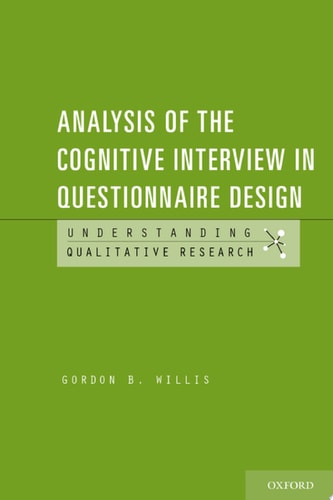
Analysis of the Cognitive Interview in Questionnaire Design
0
0
As an Amazon Associate and affiliate partner, Menrva Books earns from qualifying purchases. Learn more
Author Description
Cognitive Interviewing, Based On The Self-report Methods Of Ericsson And Simon, Is A Key Form Of Qualitative Research That Has Developed Over The Past Thirty Years. The Primary Objective Of Cognitive Interviewing, Also Known As Cognitive Testing, Is To Understand The Cognitive Mechanisms Underlying The Survey-response Process. An Equally Important Aim Is Contributing To The Development Of Best Practices For Writing Survey Questions That Are Well Understood And That Produce Low Levels Of Response Error. In Particular, An Important Applied Objective Is The Evaluation Of A Particular Set Of Questions, Items, Or Other Materials Under Development By Questionnaire Designers, To Determine Means For Rewording, Reordering, Or Reconceptualizing. Hence, As Well As Providing An Empirical, Psychologically Oriented Framework For The General Study Of Questionnaire Design, Cognitive Interviewing Has Been Adopted As A 'production' Mechanism For The Improvement Of A Wide Variety Of Survey Questions, Whether Factual, Behavioral, Or Attitudinal In Nature. As With Other Methods That Rely On Qualitative Data, Cognitive Interviewing Has Increasingly Been Criticized For Being Lax In The Critical Area Of The Development Of Systematic Methods For Data Reduction, Analysis, And Reporting Of Results. Practitioners Tend To Conduct Cognitive Interviewing In Varying Ways, And The Data Coding And Compilation Activities Undertaken Are Often Nonstandardized And Poorly Described. There Is A Considerable Need For Further Development--and Documentation--relating Not Only To A Description Of This Variation But Also To Providing A Set Of Recommendations For Minimal Standards, If Not Best Practices. The Proposed Volume Endeavors To Address This Clear Omission.
Menrva's Summary
THE THESIS
This work investigates the methodological inconsistencies in cognitive interviewing and proposes a systematic framework for the analysis and reporting of qualitative survey data. Gordon B. Willis, a specialist in questionnaire design, addresses the lack of standardized practices in cognitive testing. By examining the cognitive mechanisms of the survey-response process, the author argues for the implementation of rigorous, replicable standards to reduce response error and improve the quality of survey instruments.
THE SCOPE MAP
What You Will Find
- Theoretical foundations based on Ericsson and Simon's self-report methods
- Methodological frameworks for evaluating survey questions and items
- Strategies for rewording and reordering survey materials
- Recommendations for data reduction and standardized reporting
Scope Limits
- Does not cover quantitative statistical analysis of survey results
- Does not provide a comprehensive history of all survey methodologies
THE AUTHORITY PERSPECTIVE
Experts recognize this text as a critical intervention in the field of survey methodology, specifically addressing the long-standing issue of nonstandardized qualitative coding. Practitioners frequently cite the book as a primary resource for establishing best practices in cognitive testing and questionnaire development.
Page Count:
274
Publication Date:
2015-01-01
Publisher:
Oxford University Press, Incorporated
ISBN-10:
0190262826
ISBN-13:
9780190262822
Psychology
Cognition
Qualitative Research
Data Analysis
Social Science
Social Research
Survey Design
Social Surveys
Community Tags
Other Editions(3)
Similar Books













Reader Comments
Share Your Thoughts
No comments yet. Be the first to share your thoughts!