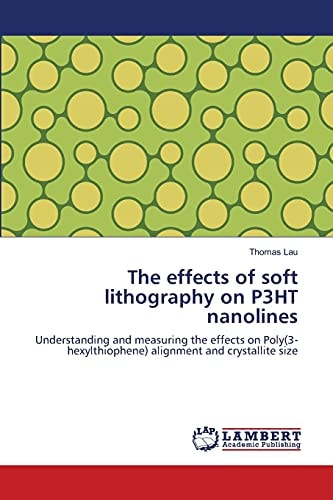
The Effects of Soft Lithography on P3HT Nanolines
0
0
As an Amazon Associate and affiliate partner, Menrva Books earns from qualifying purchases. Learn more
Author Description
We investigate the effects of three h-PDMS stamp-based nanopatterning techniques on the extent of internal alignment of poly(3-hexylthiophene) molecules and crystallite size within the fabricated nanolines. Atomic force phase imaging, x-ray diffraction and thin-film field-effect transistor measurements help provide insight into the kinds of driving forces that promote crystallization of P3HT, which is highly desirable for possible application in various optoelectronic devices. Specifically, we verify that the effects of differing rates of solvent evaporation have a clear but limited role in promoting growth of large crystallites in both unpatterned films and nanolines, which in turn results in an isotropic distribution of chains in the edge-on or face on phase regardless of the patterning technique used or the size of the h- PDMS stamp's lines. Further studies with substrates treated with silanized monolayers are necessary in order to ascertain the possibility of induced crystallite orientation due to nano- confinement by the stamps.
Menrva's Summary
THE THESIS
This paper investigates how soft lithography techniques influence the molecular alignment and crystallite size of P3HT within nanolines. The research examines three h-PDMS stamp-based nanopatterning methods, utilizing atomic force phase imaging, x-ray diffraction, and thin-film field-effect transistor measurements to understand the crystallization drivers for P3HT. It specifically addresses the limited role of solvent evaporation rates in promoting large crystallites and the resulting isotropic chain distribution, irrespective of patterning technique or stamp line size. The study concludes by suggesting further investigations with silanized monolayer-treated substrates to explore induced crystallite orientation through nano-confinement.
THE SCOPE MAP
- Analysis of three h-PDMS stamp-based nanopatterning techniques.
- Investigation of internal alignment of poly(3-hexylthiophene) molecules.
- Determination of crystallite size within fabricated nanolines.
- Utilizes atomic force phase imaging for structural analysis.
- Employs x-ray diffraction for crystallographic insights.
- Includes thin-film field-effect transistor measurements for device performance.
- Examines the role of solvent evaporation rates in P3HT crystallization.
- Discusses isotropic distribution of chains in edge-on or face-on phases.
THE AUTHORITY PERSPECTIVE
The study presents a detailed analysis of P3HT nanoline fabrication using soft lithography, focusing on the relationship between patterning techniques and material properties. It highlights the limited influence of solvent evaporation on crystallite growth and orientation, suggesting that nano-confinement effects warrant further investigation. The research provides valuable data for researchers aiming to optimize P3HT-based optoelectronic devices.
Page Count:
56
Publication Date:
2013-01-01
Publisher:
Lap Lambert Academic Publishing GmbH KG
ISBN-10:
3659497479
ISBN-13:
9783659497476
Science
Physics
Nanotechnology
Community Tags
Similar Books