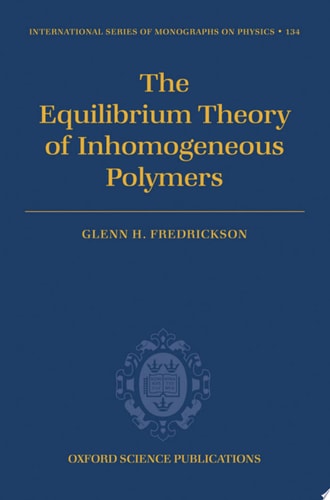
The Equilibrium Theory of Inhomogeneous Polymers
0
0
As an Amazon Associate and affiliate partner, Menrva Books earns from qualifying purchases. Learn more
Author Description
The Equilibrium Theory of Inhomogeneous Polymers provides an introduction to the field-theoretic methods and computer simulation techniques that are used in the design of structured polymeric fluids. By such methods, the principles that dictate equilibrium self-assembly in systems ranging from block and graft copolymers, to polyelectrolytes, liquid crystalline polymers, and polymer nanocomposites can be established. Building on an introductory discussion of single-polymer statistical mechanics, the book provides a detailed treatment of analytical and numerical techniques for addressing the conformational properties of polymers subjected to spatially-varying potential fields. This problem is shown to be central to the field-theoretic description of interacting polymeric fluids, and models for a number of important polymer systems are elaborated. Chapter 5 serves to unify and expound the topic of self-consistent field theory, which is a collection of analytical and numerical techniques for obtaining solutions of polymer field theory models in the mean-field approximation. The concluding Chapter 6 provides a discussion of analytical methods for going beyond the mean-field approximation and an introduction to the exciting new field of field-theoretic polymer simulations - the direct numerical simulation of polymer field theory models. No other book brings together in such a detailed and instructive fashion the theoretical and numerical tools for investigating the equilibrium structure and thermodynamics of meso-structured polymer formulations, including those relevant to soft material nanotechnologies, personal care products, and multiphase plastic materials.
Menrva's Summary
THE THESIS
This text investigates the application of field-theoretic methods and computer simulation techniques to understand and predict the equilibrium self-assembly of inhomogeneous polymeric fluids. Glenn H. Fredrickson, a prominent researcher in soft matter physics, synthesizes complex statistical mechanics with numerical modeling to provide a rigorous framework for analyzing structured polymers. The book argues that by treating polymers as systems subjected to spatially-varying potential fields, one can effectively model the thermodynamics and structural properties of diverse materials ranging from copolymers to nanocomposites.
THE SCOPE MAP
What You Will Find
- Statistical mechanics of single-polymer chains
- Self-consistent field theory (SCFT) in the mean-field approximation
- Numerical techniques for solving polymer field theory models
- Analytical methods for addressing fluctuations beyond mean-field theory
- Applications to block copolymers, polyelectrolytes, and liquid crystalline polymers
Scope Limits
- The text focuses primarily on equilibrium properties and does not cover non-equilibrium dynamics or rheology.
- It assumes a strong foundation in undergraduate-level statistical mechanics and calculus.
THE AUTHORITY PERSPECTIVE
Experts and researchers in soft matter physics recognize this work as a foundational text for understanding field-theoretic approaches to polymer systems. Readers frequently note the high level of mathematical rigor and the density of the prose, which makes it most suitable for graduate students and professional scientists in the field.
Page Count:
456
Publication Date:
2005-01-01
Publisher:
OUP Oxford
ISBN-10:
0191524328
ISBN-13:
9780191524325
Science
Earth Sciences
Physics
Thermodynamics
Nanotechnology
Industrial Technology
Textiles & Polymers
Trades & Technology
Community Tags
Other Editions(3)
Similar Books











Reader Comments
Share Your Thoughts
No comments yet. Be the first to share your thoughts!