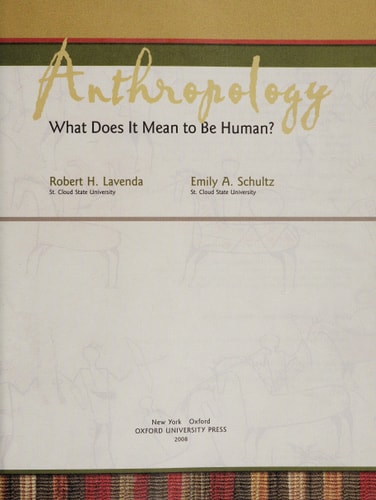
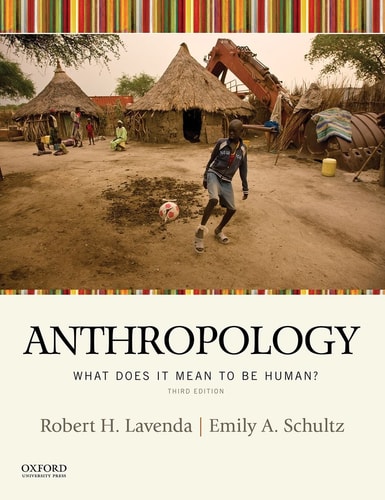
Anthropology: What Does It Mean to Be Human?
0
0
As an Amazon Associate and affiliate partner, Menrva Books earns from qualifying purchases. Learn more
Author Description
A unique alternative to more traditional, encyclopedic introductory texts, Anthropology: What Does It Mean to Be Human? takes a question-oriented approach that illuminates major concepts for students. Structuring each chapter around an important question, the authors explore what it means to be human, incorporating answers from all four subfields of anthropology--cultural anthropology, biological anthropology, linguistic anthropology, and archaeology--and offering a more balanced perspective than other texts. They address central issues of the discipline, highlighting the controversies and commitments that are shaping contemporary anthropology.FEATURES:* Covers the material in fifteen concise chapters--an ideal text for a one-semester course* Addresses issues of power and inequality in the contemporary world--including racism, ethnic discrimination, nationalism, caste, and class* Incorporates cutting-edge theory and gender and feminist anthropology throughout* Takes an explicitly global approach, discussing ways in which the spread of capitalism has drastically reshaped how people everywhere live their lives* Presents new voices and alternative perspectives from nonanthropologists and indigenous peoples through "In Their Own Words" commentaries* Provides ethnographic summaries--with maps--of each society discussed at length in the text in "EthnoProfile" boxes* Integrates additional helpful pedagogical aids including key terms, a running glossary, chapter summaries, maps, and annotated suggestions for further reading* Supplemented by an Instructor's Manual and Computerized Test Bank Course Management Systems are available from your Oxford representative.
Menrva's Summary
THE THESIS
This text investigates the fundamental question of what it means to be human by integrating the four primary subfields of anthropology into a cohesive, inquiry-based framework. Authors Emily A. Schultz and Robert H. Lavenda leverage their extensive academic backgrounds to move away from traditional encyclopedic formats, instead utilizing a question-oriented approach. By synthesizing data from cultural, biological, and linguistic anthropology alongside archaeology, the authors provide a balanced perspective on the complexities of human existence and the socio-political forces that shape contemporary life.
THE SCOPE MAP
What You Will Find
- A comprehensive overview of the four-field approach to anthropology including cultural, biological, linguistic, and archaeological perspectives.
- Analysis of systemic issues such as power, inequality, racism, nationalism, and class dynamics in a globalized world.
- Pedagogical tools including EthnoProfile boxes, running glossaries, and annotated reading suggestions for student engagement.
- Integration of diverse voices through 'In Their Own Words' commentaries from indigenous peoples and non-anthropologists.
THE AUTHORITY PERSPECTIVE
Experts and educators frequently highlight this text as a foundational resource for undergraduate students due to its accessible, question-driven structure. Readers often note the clarity of the prose and the effectiveness of the ethnographic summaries in grounding complex theoretical concepts.
Page Count:
560
Publication Date:
2007-02-16
Publisher:
Oxford University Press
ISBN-10:
0195189760
ISBN-13:
9780195189766
Politics
Social Science
Archaeology
Sociology
textbook
Anthropology
Community Tags
Other Editions(3)
Similar Books





Reader Comments
Share Your Thoughts
No comments yet. Be the first to share your thoughts!