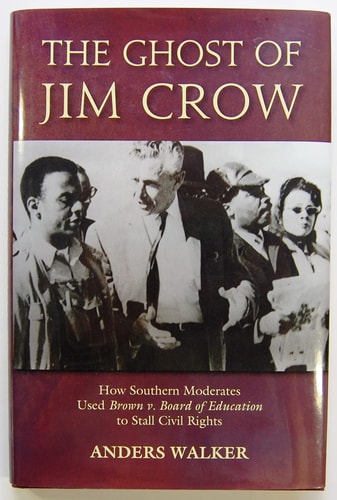
The Ghost of Jim Crow: How Southern Moderates Used Brown v. Board of Education to Stall Civil Rights
0
0
As an Amazon Associate and affiliate partner, Menrva Books earns from qualifying purchases. Learn more
Author Description
In "Letter from Birmingham Jail," Martin Luther King, Jr. asserted that "the Negro's great stumbling block in his stride toward freedom is not the White Citizen's Counciler or the Ku Klux Klanner, but the white moderate, who is more devoted to 'order' than to justice." To date, our understanding of the Civil Rights era has been largely defined by high-profile public events such as the crisis at Little Rock high school, bus boycotts, and sit-ins-incidents that were met with massive resistance and brutality. The resistance of Southern moderates to racial integration was much less public and highly insidious, with far-reaching effects. The Ghost of Jim Crow draws long-overdue attention to the moderate tactics that stalled the progress of racial equality in the South.Anders Walker explores how three moderate Southern governors formulated masked resistance in the wake of Brown v. Board of Education. J. P. Coleman in Mississippi, Luther Hodges in North Carolina, and LeRoy Collins in Florida each developed workable, lasting strategies to neutralize black political activists and control white extremists. Believing it possible to reinterpret Brown on their own terms, these governors drew on creative legal solutions that allowed them to perpetuate segregation without overtly defying the federal government. Hodges, Collins, and Coleman instituted seemingly neutral criteria--academic, economic, and moral--in place of racial classifications, thereby laying the foundations for a new way of rationalizing racial inequality. Rather than focus on legal repression, they endorsed cultural pluralism and uplift, claiming that black culture was unique and should be preserved, free from white interference. Meanwhile, they invalidated common law marriages and cut state benefits to unwed mothers, then judged black families for having low moral standards. They expanded the jurisdiction of state police and established agencies like the Mississippi Sovereignty Commission to control unrest.
Menrva's Summary
THE THESIS
This book investigates how Southern moderate governors utilized legal and administrative maneuvers to circumvent the desegregation mandates of Brown v. Board of Education. Anders Walker, a legal historian, examines the strategies of governors J. P. Coleman, Luther Hodges, and LeRoy Collins to demonstrate how they maintained segregationist structures under the guise of cultural pluralism and neutral state criteria. By analyzing state records and legislative actions, the author argues that these moderates were more effective at stalling racial equality than the more overt, violent resistance groups of the era.
THE SCOPE MAP
What You Will Find
- Analysis of post-Brown v. Board of Education legislative strategies in Mississippi, North Carolina, and Florida.
- Examination of the use of 'neutral' academic and moral criteria to enforce systemic racial inequality.
- Documentation of state-level agencies, such as the Mississippi Sovereignty Commission, used to monitor and suppress political activism.
- Evaluation of how cultural pluralism rhetoric was weaponized to justify the preservation of segregated social structures.
THE AUTHORITY PERSPECTIVE
Experts recognize this work as a significant contribution to the study of the Civil Rights era, specifically for its focus on the administrative mechanics of segregation. Readers frequently note the academic density of the prose and the author's meticulous use of primary source documentation to support his arguments.
Page Count:
241
Publication Date:
2009-07-30
Publisher:
Oxford University Press
ISBN-10:
0195181743
ISBN-13:
9780195181746
History
Civil Rights
Race Relations
Moderation
African Americans
Sociology
Topeka Kan
Southern States
Law
Community Tags
Similar Books