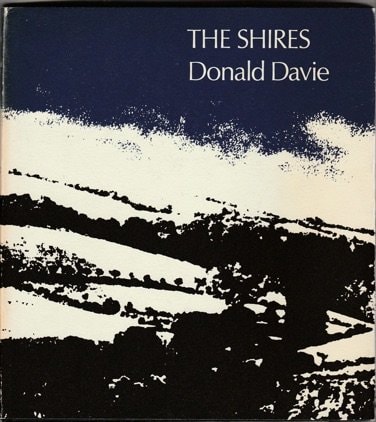
The Shires: Poems
0
0
As an Amazon Associate and affiliate partner, Menrva Books earns from qualifying purchases. Learn more
Author Description
Of Baptist parentage, Donald Davie was, to quote from an essay written in his fifties, “an Englishman bred... near to the heart of English Dissenting Protestantism.” A considerable part of his critical writing is devoted to a defense of the conservative, orthodox, dissenting tradition—Baptist, Congregationalist, and Presbyterian—which he considers to be—at least in the seventeenth and eighteenth centuries—rational, intellectual, and enlightened. While in Dublin he produced Purity of Diction in English Verse (1952), which reveals his serious interest in the technical excellence of poetry and in the moral and social implications of its subject matter, an interest he was to exhibit for the next thirty years in both his creative and his critical work. To abandon logical syntax, he states, “is to throw away a tradition central to human thought.” In Purity of Diction in English Verse Davie is chiefly concerned with literature prior to the twentieth century, but its principles regarding diction and syntax have a bearing on Davie’s own poetry and on the poetry of a number of his contemporaries, a group of like-minded poets in the 1950s which became known as The Movement. The Movement was, among other things, a sharp break with imagism and symbolism as they appear in the poetry of Pound and Eliot. Davie shared with The Movement what he called “an angry reaction from the tawdry amoralism which had destroyed Dylan Thomas,” and he mentions his indifference at that time to any poem which cannot be shown to be moral.
Menrva's Summary
THE PULSE
The collection explores the intersection of English landscape, cultural history, and the poet's own dissenting religious heritage. Through a series of poems, Davie examines the physical geography of various English shires while simultaneously mapping the intellectual and moral traditions that shaped his identity. The work functions as a meditation on the relationship between regional identity and the broader historical currents of Protestant Dissent. The narrative framework is lyrical and reflective, utilizing precise syntax to anchor abstract philosophical inquiries within specific, tangible locations.
INSIDE THE PAGES
- Exploration of regional English geography and local history
- Emphasis on logical syntax and formal technical excellence
- Integration of religious and moral themes rooted in Dissenting Protestantism
- Rejection of imagist and symbolist poetic conventions
- Intellectual engagement with the tradition of eighteenth-century verse
- Focus on the social and moral implications of poetic diction
- Meditations on the concept of 'Englishness' and cultural heritage
- Structured, disciplined verse forms reflecting the author's critical principles
THE COLLECTIVE ECHO
Readers and critics often identify this collection as a quintessential example of Davie’s commitment to the principles of The Movement. Discussion frequently centers on the poet's rigorous attention to syntax and his deliberate avoidance of the emotive excesses found in earlier modernist works. Scholars highlight the balance between the descriptive, topographical elements of the poems and the underlying theological arguments that inform the author's worldview. The work is widely regarded as a significant contribution to mid-twentieth-century British poetry, valued for its intellectual clarity and its refusal to abandon traditional logical structures.
Page Count:
64
Publication Date:
1975-01-01
Publisher:
Oxford University Press
ISBN-10:
019519814X
ISBN-13:
9780195198140
Poetry
Modernism
British literature
English literature
Literary Criticism
Community Tags
Similar Books