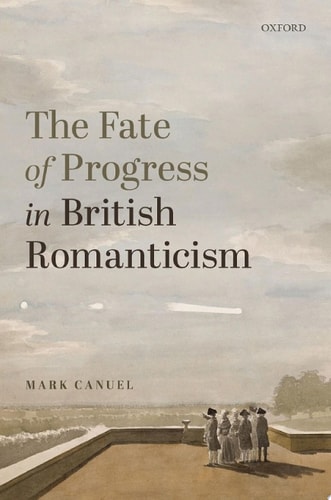
The Fate of Progress in British Romanticism
0
0
As an Amazon Associate and affiliate partner, Menrva Books earns from qualifying purchases. Learn more
Author Description
What did Romantic writers mean when they wrote about "progress" and "perfection"? This book shows how Romantic writers inventively responded to familiar ideas about political progress which they inherited from the eighteenth century. Whereas earlier writers such as Voltaire and John Millar likened improvements in political institutions to the progress of the sciences or refinement of manners, the novelists, poets, and political theorists examined in this book reimagined politically progressive thinking in multiple genres. While embracing a commitment to optimistic improvement--increasing freedom, equality, and protection from injury--they also cultivated increasingly visible and volatile energies of religious and political dissent. Earlier narratives of progress tended not only to edit and fictionalize history but also to agglomerate different modes of knowledge and practice in their quest to describe and prescribe uniform cultural improvement. But romantic writers seize on internal division and take it less as an occasion for anxiety, exclusion, or erasure, and more as an impetus to rethink the groundwork of progress itself. Political entities, from Percy Shelley's plans for political reform to Charlotte Smith's motley associations of strangers in The Banished Man, are progressive because they advance some version of collective utility or common good. But they simultaneously stake a claim to progress only insofar as they paradoxically solicit contending vantage points on the criteria for the very public benefit which they passionately pursue. The "majestic edifices" of Wordsworth's imagined university in The Prelude embrace members who are "republican or pious," not to mention the recalcitrant "enthusiast" who is the poet himself.
Menrva's Summary
THE THESIS
This book investigates how British Romantic writers redefined the Enlightenment concept of progress by integrating political dissent and internal social division into their frameworks of improvement. Author Mark Canuel, a scholar of Romantic-era literature and political thought, examines how poets, novelists, and theorists moved away from the uniform, linear models of progress inherited from eighteenth-century thinkers like Voltaire. By analyzing works from authors such as Percy Shelley and Charlotte Smith, Canuel argues that Romantic writers viewed the inclusion of conflicting perspectives as a necessary component of a truly progressive society.
THE SCOPE MAP
What You Will Find
- Analysis of political reform theories in the works of Percy Shelley and Charlotte Smith
- Examination of the shift from Enlightenment-era uniform progress to Romantic-era pluralistic models
- Discussion of religious and political dissent as catalysts for social improvement
- Exploration of the concept of collective utility in literary texts
Scope Limits
- The study focuses primarily on British Romanticism and does not provide a comprehensive survey of European-wide Romantic movements
- The text does not offer a general history of political progress but specifically targets the literary and theoretical responses of the period
THE AUTHORITY PERSPECTIVE
Scholars in the field of Romantic studies recognize this work as a significant contribution to understanding the intersection of political theory and literary form. Readers frequently note the academic density of the prose, which is intended for an audience familiar with the nuances of eighteenth and nineteenth-century political discourse.
Page Count:
250
Publication Date:
2022-01-01
Publisher:
OUP Oxford
ISBN-10:
0192648470
ISBN-13:
9780192648471
History
British literature
Indigenous
Political Theory
In literature
English literature
Literary Criticism
Romanticism
Romantisme
History of Ideas
Community Tags
Similar Books