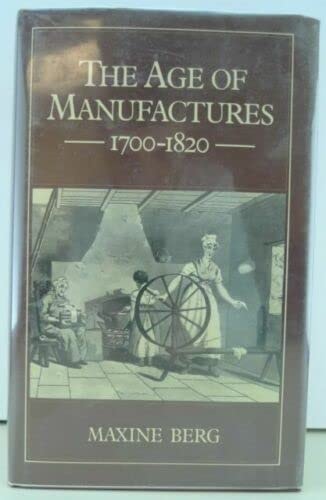
The Age of Manufactures, 1700-1820: Industry, Innovation, and Work in Britain
0
0
As an Amazon Associate and affiliate partner, Menrva Books earns from qualifying purchases. Learn more
Author Description
Drawing on economic, social, and cultural history, this revisionist work presents a fascinating overview of the early industrialization process in the 18th century. Challenging conventional economic historians, Berg demonstrates that the age of manufactures was rather a complex web of improvement and decline, large- and small-scale production, and machine and hand processes. Berg looks well beyond the factory system and cotton industry to the whole range of metal and textile industries, analyzing the ubiquity and success of workship, artisan, and domestic systems of manufacture.
Menrva's Summary
THE THESIS
This work investigates the complexity of the early British industrialization process, challenging the traditional focus on the factory system as the sole driver of economic change. Maxine Berg, a prominent economic historian, utilizes a synthesis of social, cultural, and economic data to argue that the 18th-century economy was defined by a diverse mixture of artisan, domestic, and small-scale production methods alongside emerging mechanized systems. By expanding the analytical lens beyond cotton and large factories, the author provides a nuanced framework for understanding the multifaceted nature of industrial growth.
THE SCOPE MAP
What You Will Find
- Analysis of the metal and textile industries beyond the cotton sector
- Examination of the coexistence of hand-production and machine-based manufacturing
- Integration of social and cultural history with traditional economic data
- Evaluation of the role of workshops and artisan labor in the 18th-century economy
THE AUTHORITY PERSPECTIVE
Historians and scholars frequently cite this work as a foundational text for understanding the diversity of early industrial labor structures. Experts highlight the author's ability to synthesize complex economic data into a readable and persuasive revisionist argument.
Page Count:
378
Publication Date:
1986-04-10
Publisher:
Oxford University Press
ISBN-10:
0195205006
ISBN-13:
9780195205008
History
Economics
Manufactures
British History
Industries
Social History
Community Tags
Similar Books