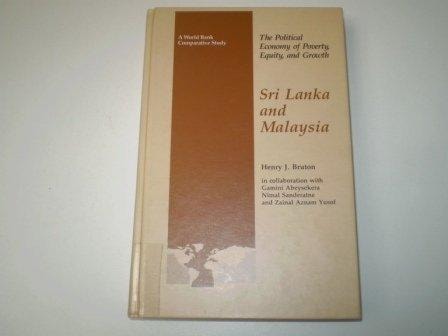
The Political Economy of Poverty, Equity, and Growth: Sri Lanka and Malaysia
0
0
As an Amazon Associate and affiliate partner, Menrva Books earns from qualifying purchases. Learn more
Author Description
Sri Lanka and Malaysia have many traits in common--both were former colonies, have similar land areas and resource endowments, and they have plantation and mining export sectors which co-exist with subsistence farming with the major crop as rice. Bruton examines these similarities and contrast the differences that exist. He emphasizes the constraints within each country's government policies, evaluating the origins and legitimacies of these restrictions. As with other titles in the series, this work provides an historical narrative with which to understand the path of development each country has taken.
Menrva's Summary
THE THESIS
This study investigates the divergent economic development paths of Sri Lanka and Malaysia to determine how specific government policies and historical constraints influenced their respective trajectories of poverty, equity, and growth. Henry J. Bruton, an economist associated with World Bank research, utilizes a comparative framework to analyze these two nations, which share similar colonial histories, land areas, and resource endowments. By evaluating the origins and legitimacies of policy restrictions within each country, the author constructs a historical narrative that explains why these two nations achieved different developmental outcomes despite their initial similarities.
THE SCOPE MAP
What You Will Find
- Comparative analysis of post-colonial economic development in Sri Lanka and Malaysia.
- Evaluation of government policy constraints regarding plantation, mining, and subsistence agricultural sectors.
- Historical narrative detailing the evolution of national economic strategies.
- Assessment of the relationship between resource endowments and long-term growth patterns.
THE AUTHORITY PERSPECTIVE
Experts recognize this work as a foundational comparative study within the World Bank's series on political economy. Readers frequently note the academic density of the prose and the rigorous historical approach used to isolate policy variables in developing nations.
Page Count:
436
Publication Date:
1992-05-07
Publisher:
Oxford University Press
ISBN-10:
0195208242
ISBN-13:
9780195208245
Economics
History
Asian Studies
Developing Countries
Malaysia
Community Tags
Similar Books