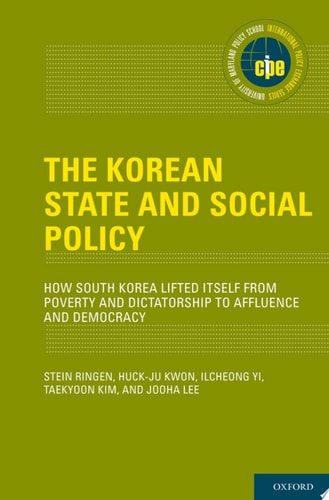
The Korean State and Social Policy: How South Korea Lifted Itself from Poverty and Dictatorship to Affluence and Democracy
0
0
As an Amazon Associate and affiliate partner, Menrva Books earns from qualifying purchases. Learn more
Author Description
There are two great mysteries in the political economy of South Korea. How could a destroyed country in next to no time become a sophisticated and affluent economy? And how could a ruthlessly authoritarian regime metamorphose with relative ease into a stable democratic polity? South Korea was long ruled with harsh authoritarianism, but, strangely, the authoritarian rulers made energetic use of social policy. The Korean State and Social Policy observes South Korean public policy from 1945 to 2000 through the prism of social policy to examine how the rulers operated and worked. After the military coup in 1961, the new leaders used social policy to buy themselves legitimacy. That enabled them to rule in two very different ways simultaneously. In their determination to hold on to power they were without mercy, but in the use of power in governance, their strategy was to co-opt and mobilize with a sophistication that is wholly exceptional among authoritarian rulers. It is governance and not power that explains the Korean miracle.Mobilization is a strategy with consequences. South Korea was not only led to economic development but also, inadvertently perhaps, built up as a society rich in public and civil institutions. When authoritarianism collapsed under the force of nationwide uprisings in 1987, the institutions of a reasonably pluralistic social and political order were there, alive and well, and democracy could take over without further serious drama.This book is about many things: development and modernization, dictatorship and democracy, state capacity and governance, social protection and welfare states, and Korean history. But finally it is about lifting social policy analysis out of the ghetto of self-sufficiency it is often confined to and into the center ground of hard political science.
Menrva's Summary
THE THESIS
This book investigates the paradox of South Korea's rapid transformation from a war-torn, authoritarian state into a prosperous, stable democracy by analyzing the strategic role of social policy. The authors, a team of scholars including Huck-ju Kwon and Stein Ringen, utilize historical data and political analysis to argue that the South Korean state utilized social policy not merely as a welfare tool, but as a sophisticated mechanism for governance, legitimacy, and institutional development. By examining the period from 1945 to 2000, the text demonstrates how these state-led initiatives inadvertently fostered the civil and public institutions necessary for a peaceful transition to democracy.
THE SCOPE MAP
What You Will Find
- Historical analysis of South Korean public policy from 1945 to 2000.
- Examination of the relationship between authoritarian rule and social welfare mobilization.
- Case studies on the transition from military dictatorship to democratic governance.
- Theoretical framework linking state capacity, social protection, and political legitimacy.
THE AUTHORITY PERSPECTIVE
Experts identify this work as a significant contribution to the study of developmental states and the political economy of East Asia. Readers frequently note the academic rigor of the text, which successfully positions social policy as a central element of political science rather than a peripheral concern.
Page Count:
146
Publication Date:
2011-01-01
Publisher:
Oxford University Press
ISBN-10:
0199875936
ISBN-13:
9780199875931
History
Economics
Public Policy
Sociology
Developing Countries
State The
Korea
Asian Studies
Community Tags
Similar Books















Reader Comments
Share Your Thoughts
No comments yet. Be the first to share your thoughts!