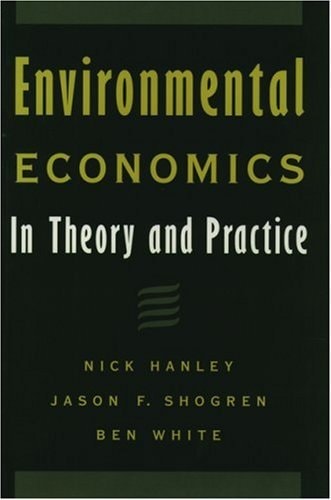
Environmental Economics: In Theory and Practice
0
0
As an Amazon Associate and affiliate partner, Menrva Books earns from qualifying purchases. Learn more
Author Description
Environmental Economics in Theory and Practice provides a thorough and coherent review and discussion of environmental economics. It is a guide to the most important areas of natural resource and environmental economics, including the economics of non-renewable and renewable resource extraction, the economics of pollution control, the application of cost-benefit analysis to the environment, and the economics of sustainable development. The book concentrates on key elements of economic theory, and shows how they can be applied to real-world problems. Particular emphasis is placed on analyzing recent empirical studies from all over the world along with in-depth coverage of various economic models. Each chapter develops the main theoretical results and recent analytic techniques necessary for understanding applications. Throughout the book, results are presented in words, graphs, and mathematical models; brief technical notes inform readers about optimal control theory, the Kuhn-Tucker conditions, game theory, and linear programming. Moving through the laws of thermodynamics to an analysis of market failure, the book turns to the economics of natural resources and pollution control. It concludes with an examination of environmental cost-benefit analysis and sustainable development. A comprehensive text, it is particularly suitable for use in advanced undergraduate and graduate courses in environmental and resource economics. Because of up-to-date coverage, it will also be of interest to professionals working in resource and environmental economics.
Menrva's Summary
THE THESIS
This text investigates the intersection of economic theory and environmental management to determine how market mechanisms can address natural resource depletion and pollution. The authors, Ben White, Nick Hanley, and Jason F. Shogren, leverage their academic expertise to synthesize complex economic models with empirical evidence from global case studies. The book establishes a rigorous framework for applying cost-benefit analysis and sustainable development strategies to contemporary ecological challenges.
THE SCOPE MAP
What You Will Find
- Theoretical analysis of non-renewable and renewable resource extraction models.
- Methodological applications of cost-benefit analysis in environmental policy.
- Technical integration of optimal control theory, game theory, and linear programming.
- Empirical review of market failure and pollution control mechanisms.
THE AUTHORITY PERSPECTIVE
Experts identify this work as a foundational text for advanced undergraduate and graduate curricula in environmental economics. Readers frequently note the technical density of the prose, which requires a solid grasp of mathematical modeling to fully utilize the provided analytical tools.
Page Count:
480
Publication Date:
1996-11-14
Publisher:
Oxford University Press
ISBN-10:
0195212541
ISBN-13:
9780195212549
Economics
Public Policy
Sustainability
Natural Resources
Community Tags
Similar Books