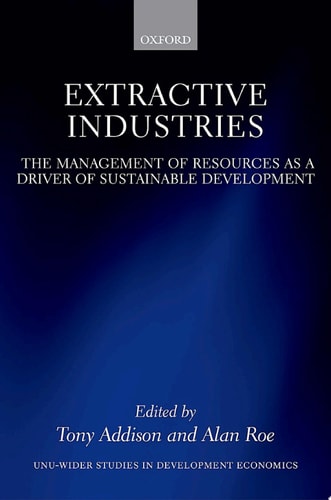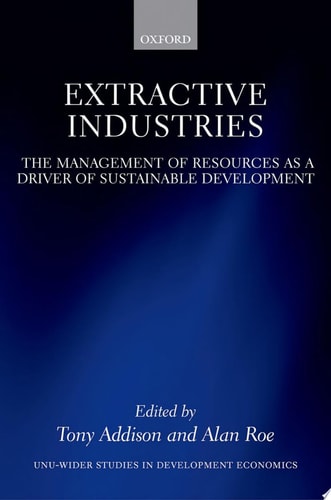
Extractive Industries: The Management of Resources as a Driver of Sustainable Development
0
0
As an Amazon Associate and affiliate partner, Menrva Books earns from qualifying purchases. Learn more
Author Description
This is an open access title available under the terms of a CC BY-NC-SA 3.0 IGO licence. It is free to read at Oxford Scholarship Online and offered as a free PDF download from OUP and selected open access locations. New initiatives recognize that resource wealth can provide a means, when properly used, for poorer nations to decisively break with poverty by diversifying economies and funding development spending. Extractive Industries: The Management of Resources as a Driver of Sustainable Development explores the challenges and opportunities facing developing countries in using oil, gas, and mining to achieve inclusive change. While resource wealth can yield prosperity it can also, when mismanaged, cause acute social inequality, deep poverty, environmental damage, and political instability. There is a new determination to improve the benefits of extractive industries to their host countries, and to strengthen the sector's governance. Extractive Industries provides a comprehensive contribution to what must be done in this sector to deliver development, protect often fragile environments from damage, enhance the rights of affected communities, and support climate change action. It brings together international experts to offer ideas and recommendations in the main policy areas. With a breadth of collective insight and experience, it argues that more attention must be given to the development role of extractive industries, and looks to the future to explain how action on climate change will profoundly shape the sector's prospects.
Menrva's Summary
THE THESIS
This book investigates how developing nations can effectively leverage oil, gas, and mining wealth to foster sustainable development while mitigating the risks of inequality and political instability. The authors, Alan Roe and Professor Tony Addison, synthesize contributions from international experts to provide a framework for governance, environmental protection, and economic diversification. The text argues that resource wealth is not inherently beneficial or detrimental, but rather depends on the quality of institutional management and policy implementation.
THE SCOPE MAP
What You Will Find
- Analysis of economic diversification strategies for resource-dependent nations
- Governance frameworks for managing extractive sector revenues
- Policy recommendations for balancing industrial growth with climate change mitigation
- Strategies for protecting local communities and fragile environments
Scope Limits
- Does not provide specific technical engineering manuals for extraction operations
- Does not focus on the internal corporate management of private mining firms
THE AUTHORITY PERSPECTIVE
Experts recognize this volume as a comprehensive resource for policymakers and development practitioners navigating the complexities of the extractive sector. Readers frequently note the academic density of the prose, which provides a rigorous foundation for understanding the intersection of resource economics and sustainable development.
Page Count:
704
Publication Date:
2018-01-01
Publisher:
Oxford University Press
ISBN-10:
0192549545
ISBN-13:
9780192549549
Economics
Public Policy
Natural Resources