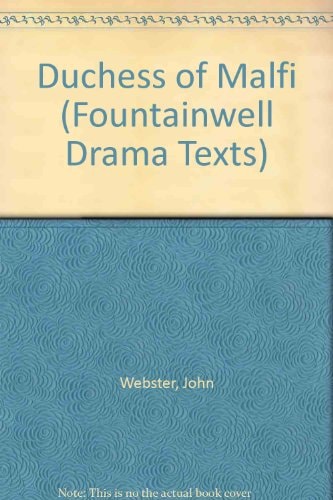
The Duchess of Malfi; (The Fountainwell drama texts, 18)
0
0
As an Amazon Associate and affiliate partner, Menrva Books earns from qualifying purchases. Learn more
Author Description
"The Duchess of Malfi" was published in 1623, but the date of writing may have been as early as 1611. It is based on a story in Painter's "Palace of Pleasure," translated from the Italian novelist, Bandello; and it is entirely possible that it has a foundation in fact. In any case, it portrays with a terrible vividness one side of the court life of the Italian Renaissance; and its picture of the fierce quest of pleasure, the recklessness of crime, and the worldliness of the great princes of the Church finds only too ready corroboration in the annals of the time. Of John Webster's life almost nothing is known. The dates 1580-1625 given for his birth and death are conjectural inferences, about which the best that can be said is that no known facts contradict them.The first notice of Webster so far discovered shows that he was collaborating in the production of plays for the theatrical manager, Henslowe, in 1602, and of such collaboration he seems to have done a considerable amount. Four plays exist which he wrote alone, "The White Devil," "The Duchess of Malfi," "The Devil's Law-Case," and "Appius and Virginia." Webster's tragedies come toward the close of the great series of tragedies of blood and revenge, in which "The Spanish Tragedy" and "Hamlet" are landmarks, but before decadence can fairly be said to have set in. He, indeed, loads his scene with horrors almost past the point which modern taste can bear; but the intensity of his dramatic situations, and his superb power of flashing in a single line a light into the recesses of the human heart at the crises of supreme emotion, redeems him from mere sensationalism, and places his best things in the first rank of dramatic writing.
Menrva's Summary
THE PULSE
The Duchess of Malfi centers on the clandestine marriage of a widowed Duchess to her steward, an act of defiance that triggers a campaign of psychological and physical torment by her vengeful brothers. The protagonist seeks personal autonomy and domestic happiness within a rigid, corrupt social hierarchy that demands strict adherence to class and familial expectations. Her brothers, the Cardinal and Duke Ferdinand, employ a network of spies and assassins to dismantle her life, utilizing the constraints of the Italian Renaissance court to enforce their will. The narrative unfolds through a dramatic structure that emphasizes the rapid descent from courtly intrigue into visceral, macabre violence.
INSIDE THE PAGES
- Use of the revenge tragedy framework common to the Jacobean era
- Exploration of moral corruption within the ecclesiastical and aristocratic classes
- Integration of macabre imagery and psychological horror
- Focus on the tension between individual desire and societal duty
- Characterization of the Duchess as a figure of resilience against systemic oppression
- Deployment of complex, morally ambiguous antagonists
- Stylistic reliance on intense, concentrated dialogue to reveal character interiority
- Thematic focus on the transience of power and the inevitability of death
THE COLLECTIVE ECHO
Discussion often centers on the play's extreme use of violence and its place within the tradition of revenge tragedies. Readers frequently highlight the contrast between the Duchess's internal strength and the external cruelty imposed by her brothers. Critics often examine the play's cynical view of court life and the effectiveness of its atmospheric, often claustrophobic, setting. Many analyses focus on the linguistic precision Webster employs to convey profound emotional states during moments of crisis. The work remains a subject of study for its ability to balance sensationalist elements with genuine psychological insight.
Page Count:
144
Publication Date:
1972-01-01
Publisher:
Oliver and Boyd
ISBN-10:
0050024957
ISBN-13:
9780050024959
Drama
Renaissance
Dramas & Plays
Jacobean Drama
Genre Fiction
British & Irish
Classics
Literary
Tragedy
Urban Life
Classic Literature
Community Tags
Similar Books