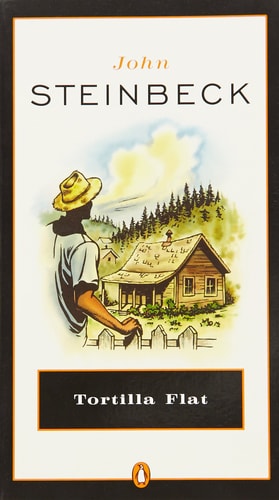
Tortilla Flat
0
0
As an Amazon Associate and affiliate partner, Menrva Books earns from qualifying purchases. Learn more
Author Description
Adopting the structure and themes of the Arthurian legend, John Steinbeck created a “Camelot” on a shabby hillside above the town of Monterey, California, and peopled it with a colorful band of knights. At the center of the tale is Danny, whose house, like Arthur’s castle, becomes a gathering place for men looking for adventure, camaraderie, and a sense of belonging—men who fiercely resist the corrupting tide of honest toil and civil rectitude.As Nobel Prize winner Steinbeck chronicles their deeds—their multiple lovers, their wonderful brawls, their Rabelaisian wine-drinking—he spins a tale as compelling and ultimately as touched by sorrow as the famous legends of the Round Table, which inspired him.
Menrva's Summary
THE PULSE
Danny, a young man of the paisano class, inherits two houses in Tortilla Flat, inadvertently establishing a sanctuary for his displaced and eccentric companions. Danny’s objective is to maintain his autonomy and social standing among his peers while navigating the demands of his newfound property ownership. He faces opposition from the societal expectations of honest labor and the inherent instability of his group of friends, who prioritize wine and camaraderie over material gain. The narrative framework utilizes a third-person perspective that mirrors the structure of Arthurian romance, framing the squalid hillside of Monterey as a legendary kingdom. The physical world is defined by the poverty of the Depression-era California coast, where the characters exist on the fringes of the formal economy.
INSIDE THE PAGES
- Arthurian legend structural parallels
- Episodic picaresque narrative style
- Focus on the paisano subculture of Monterey
- Exploration of communal living and friendship
- Satirical commentary on social rectitude
- Rabelaisian humor and dialogue
- Themes of poverty and social marginalization
- Tragicomic tone shifts
THE COLLECTIVE ECHO
Discussion often centers on Steinbeck’s deliberate use of the Arthurian mythos to elevate the lives of marginalized characters. Readers frequently highlight the balance between the humorous, often chaotic antics of the protagonists and the underlying melancholy of their precarious existence. Critics often note the effectiveness of the atmosphere, which captures a specific time and place in California history with distinct clarity. The work is widely recognized for its departure from the author's more somber social realism, offering a lighter yet poignant examination of human connection.
Page Count:
224
Publication Date:
1977-04-28
Publisher:
Penguin Books
ISBN-10:
0140042407
ISBN-13:
9780140042405
Literary Fiction
Humor
Historical
Literary
Custom Stores
Self Service
Regional
classic
Genre Fiction
Classics
Picaresque
Community Tags
Other Editions(19)
Penguin Group (USA), Inc.
2008
Default edition
Prince Frederick, Md. : Record Books,
1999

Acento Editorial
1997
Penguin
1997

Viking Press
1995

Penguin Books
1995

Mandarin
1995

Chivers
1994

G.K. Hall
1994

Mandarin
1990

Turtleback
1986
Penguin Books
1977

Pan Books
1975

Penguin Books
1967

Bantam Books
1965

Penguin Books
1950

Lythway Press
1935

Grosset & Dunlap
1935

Sahara Publisher Books
1895

Reader Comments
Share Your Thoughts
No comments yet. Be the first to share your thoughts!