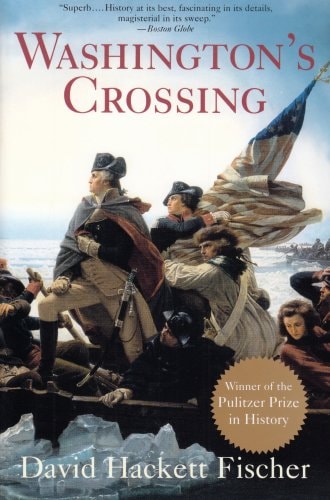
Washington's Crossing
0
0
As an Amazon Associate and affiliate partner, Menrva Books earns from qualifying purchases. Learn more
Author Description
Six months after the Declaration of Independence, the American Revolution was all but lost. A powerful British force had routed the Americans at New York, occupied three colonies, and advanced within sight of Philadelphia.Yet, as David Hackett Fischer recounts in this riveting history, George Washington--and many other Americans--refused to let the Revolution die. On Christmas night, as a howling nor'easter struck the Delaware Valley, he led his men across the river and attacked the exhausted Hessian garrison at Trenton, killing or capturing nearly a thousand men. A second battle of Trenton followed within days. The Americans held off a counterattack by Lord Cornwallis's best troops, then were almost trapped by the British force. Under cover of night, Washington's men stole behind the enemy and struck them again, defeating a brigade at Princeton. The British were badly shaken. In twelve weeks of winter fighting, their army suffered severe damage, their hold on New Jersey was broken, and their strategy was ruined.Fischer's richly textured narrative reveals the crucial role of contingency in these events. We see how the campaign unfolded in a sequence of difficult choices by many actors, from generals to civilians, on both sides. While British and German forces remained rigid and hierarchical, Americans evolved an open and flexible system that was fundamental to their success. The startling success of Washington and his compatriots not only saved the faltering American Revolution, but helped to give it new meaning.
Menrva's Summary
THE THESIS
How did a series of desperate winter maneuvers by George Washington and his Continental Army fundamentally alter the trajectory of the American Revolution? David Hackett Fischer, a distinguished historian, utilizes primary source documents and military records to analyze the strategic shift from British rigidity to American flexibility. The book argues that the success of the Trenton and Princeton campaigns was not merely a military victory, but a result of evolving social and tactical systems that allowed the Americans to overcome overwhelming odds.
THE SCOPE MAP
What You Will Find
- Detailed analysis of the Delaware Valley campaign during the winter of 1776-1777.
- Comparative study of British hierarchical military structures versus American decentralized tactics.
- Examination of the role of contingency and individual decision-making by both military leaders and civilians.
- Strategic assessment of the battles of Trenton and Princeton and their impact on British control of New Jersey.
THE AUTHORITY PERSPECTIVE
Historians and military scholars frequently cite this work as a definitive account of the mid-Revolutionary period due to its meticulous research and narrative clarity. Readers often note the academic density of the prose, which provides a comprehensive look at the logistical and social complexities of 18th-century warfare.
Page Count:
0
Publication Date:
2006-02-01
Publisher:
Oxford University Press
ISBN-10:
0195306767
ISBN-13:
9780195306767
Biography
History
American Revolution
Americas
Military History
18th century
Community Tags
Other Editions(5)


Similar Books








Reader Comments
Share Your Thoughts
No comments yet. Be the first to share your thoughts!