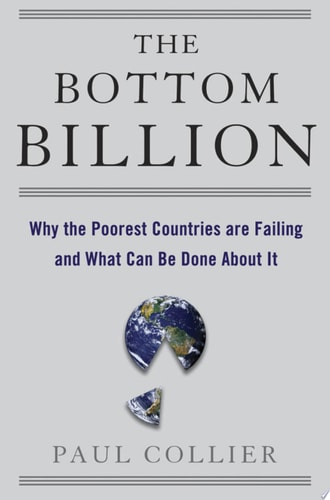
The Bottom Billion: Why the Poorest Countries are Failing and What Can Be Done About It
0
0
As an Amazon Associate and affiliate partner, Menrva Books earns from qualifying purchases. Learn more
Author Description
In the universally acclaimed and award-winning The Bottom Billion, Paul Collier reveals that fifty failed states--home to the poorest one billion people on Earth--pose the central challenge of the developing world in the twenty-first century. The book shines much-needed light on this group of small nations, largely unnoticed by the industrialized West, that are dropping further and further behind the majority of the world's people, often falling into an absolute decline in living standards. A struggle rages within each of these nations between reformers and corrupt leaders--and the corrupt are winning. Collier analyzes the causes of failure, pointing to a set of traps that ensnare these countries, including civil war, a dependence on the extraction and export of natural resources, and bad governance. Standard solutions do not work, he writes; aid is often ineffective, and globalization can actually make matters worse, driving development to more stable nations. What the bottom billion need, Collier argues, is a bold new plan supported by the Group of Eight industrialized nations. If failed states are ever to be helped, the G8 will have to adopt preferential trade policies, new laws against corruption, new international charters, and even conduct carefully calibrated military interventions. Collier has spent a lifetime working to end global poverty. In The Bottom Billion, he offers real hope for solving one of the great humanitarian crises facing the world today.
Menrva's Summary
THE THESIS
Paul Collier investigates why the poorest nations on Earth remain trapped in poverty despite decades of international aid and global economic growth. Drawing on his extensive background as a development economist and former director of the Development Research Group at the World Bank, Collier argues that these nations are caught in a series of structural 'traps' that prevent them from participating in the global economy. He posits that traditional aid models are insufficient and proposes a coordinated international strategy involving trade policy, legal reform, and security intervention to break these cycles of failure.
THE SCOPE MAP
What You Will Find
- Analysis of the four primary traps: conflict, natural resources, landlocked geography, and bad governance.
- Evaluation of the effectiveness of foreign aid and international trade policies.
- Case studies of failed states and the internal struggle between reformers and corrupt regimes.
- Proposed policy frameworks for the G8, including military intervention and international charters.
THE AUTHORITY PERSPECTIVE
Experts and critics frequently cite this work as a foundational text for understanding the complexities of modern development economics. Readers often note the accessible yet rigorous nature of the analysis, which balances statistical data with clear, actionable policy recommendations.
Page Count:
205
Publication Date:
2007-01-01
Publisher:
Oxford University Press
ISBN-10:
0195311450
ISBN-13:
9780195311457
Economics
Non-Fiction
Sociology
Poor
Poverty
International Cooperation
International relations