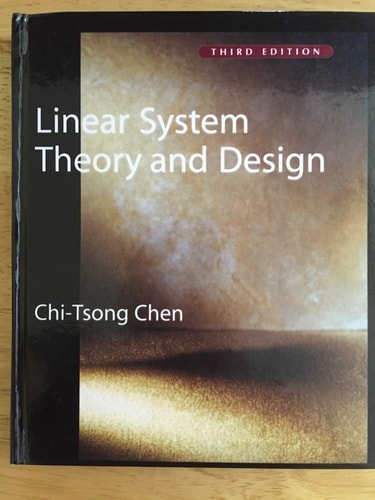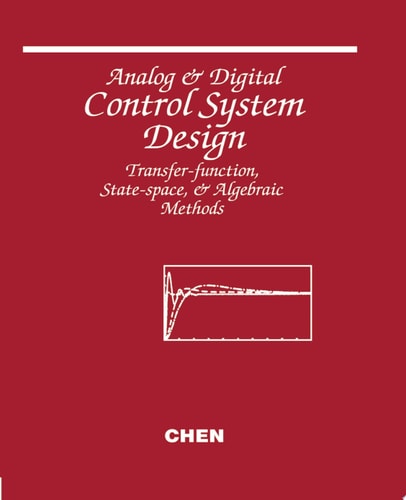
Analog and Digital Control System Design: Transfer-Function, State-Space, and Algebraic Methods
0
0
As an Amazon Associate and affiliate partner, Menrva Books earns from qualifying purchases. Learn more
Author Description
This text's contemporary approach focuses on the concepts of linear control systems, rather than computational mechanics. Straightforward coverage includes an integrated treatment of both classical and modern control system methods. The text emphasizes design with discussions of problem formulation, design criteria, physical constraints, several design methods, and implementation of compensators. Discussions of topics not found in other texts--such as pole placement, model matching and robust tracking--add to the text's cutting-edge presentation. Students will appreciate the applications and discussions of practical aspects, including the leading problem in developing block diagrams, noise, disturbances, and plant perturbations. State feedback and state estimators are designed using state variable equations and transfer functions, offering a comparison of the two approaches. The incorporation of MATLAB throughout the text helps students to avoid time-consuming computation and concentrate on control system design and analysis.
Menrva's Summary
THE THESIS
This text investigates the fundamental principles and practical methodologies required for the design of linear control systems, bridging the gap between classical transfer-function approaches and modern state-space techniques. Chi-Tsong Chen provides a comprehensive framework that prioritizes conceptual understanding over rote computational mechanics. By integrating design criteria, physical constraints, and implementation strategies, the author establishes a rigorous methodology for engineers to formulate and solve complex control problems.
THE SCOPE MAP
What You Will Find
- Integrated treatment of classical transfer-function and modern state-space control methods
- Advanced design topics including pole placement, model matching, and robust tracking
- Practical analysis of noise, disturbances, and plant perturbations in system design
- Application of MATLAB for computational efficiency and system simulation
- Detailed examination of state feedback and state estimators
THE AUTHORITY PERSPECTIVE
Experts and educators frequently cite this work as a foundational text for its clear, conceptual approach to control system design. Students and professionals often note the text's effectiveness in balancing theoretical rigor with the practical implementation of compensators.
Page Count:
624
Publication Date:
2006-02-24
Publisher:
Oxford University Press
ISBN-10:
0195310462
ISBN-13:
9780195310467
Mathematics
Control systems
textbook
Technology
Engineering
Community Tags
Similar Books