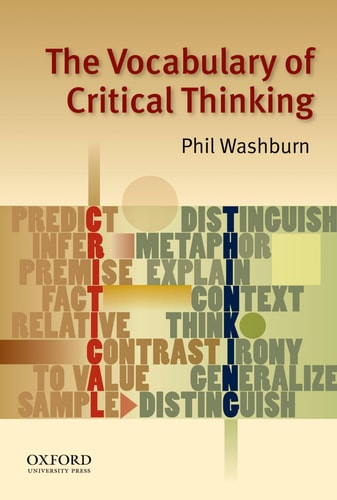
The Vocabulary of Critical Thinking
0
0
As an Amazon Associate and affiliate partner, Menrva Books earns from qualifying purchases. Learn more
Author Description
The Vocabulary of Critical Thinking offers an innovative way to improve students' thinking skills. It begins at a practical level by helping students master the crucial terms that are the building blocks of critical thinking--terms such as "generalization," "inferring," "to confirm," "justifying," "assumption," and others. The book provides hundreds of short, accessible readings that illustrate the concepts and related thinking skills. It explains in a step-by-step fashion how students can perform the specific skills themselves.Organized around nine basic skills--including comparing, generalizing, inferring, judging sources, experimenting, making value judgments, defining terms, assuming, and thinking creatively--The Vocabulary of Critical Thinking walks students through definitions, explanations, and applications of 108 words. Each chapter is comprised of four parts. The first part establishes a solid foundation by defining six or seven words related to one skill. The second part gives interesting real-world examples (from books and newspapers) that illustrate the concepts. The third part includes exercises allowing students to analyze a writer's arguments and thinking. Finally, each chapter ends with writing exercises that help students use a particular skill in their own writing.As students learn specific definitions of such terms as "analogy," "sample," and "hypothesis," they will gain a better understanding of how writers use the terms. By studying the words in context, along with author Phil Washburn's commentary and questions, they will come to understand such vital types of thinking as assessing sources, determining causes, and recognizing fallacies. Students will improve their competence gradually, without being intimidated by abstract rules and technical terms.Enhanced by numerous study questions, exercises, arguments for analysis, and writing tasks, The Vocabulary of Critical Thinking also features drawings, photographs, and an annotated bibliography.
Menrva's Summary
THE THESIS
This book investigates how mastering a specific vocabulary of 108 key terms can fundamentally improve a student's ability to perform critical thinking tasks. Author Phil Washburn, an experienced educator, presents a structured framework that moves away from abstract theory toward practical application. By utilizing real-world examples and step-by-step exercises, the text argues that linguistic precision is the primary building block for developing logical competence and analytical rigor.
THE SCOPE MAP
What You Will Find
- A pedagogical framework organized around nine fundamental cognitive skills including generalizing, inferring, and defining terms.
- A glossary-based approach covering 108 essential terms used in academic and professional argumentation.
- Practical exercises involving the analysis of real-world texts, newspaper articles, and diverse arguments.
- Integrated writing tasks designed to help students apply specific critical thinking concepts to their own compositions.
THE AUTHORITY PERSPECTIVE
Educators frequently highlight this text as a highly accessible entry point for students who find traditional logic textbooks overly abstract or intimidating. The consensus among users is that the book's modular, exercise-heavy structure makes it an effective tool for classroom instruction and independent skill development.
Page Count:
400
Publication Date:
2009-01-07
Publisher:
Oxford University Press
ISBN-10:
0195324803
ISBN-13:
9780195324808
Philosophy
Logic
Reasoning
Study Skills
Critical thinking
Education
Community Tags
Similar Books