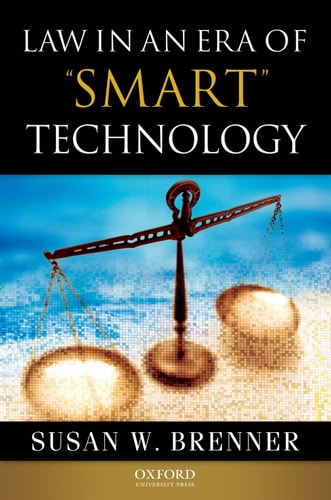
Law in an Era of Smart Technology
0
0
As an Amazon Associate and affiliate partner, Menrva Books earns from qualifying purchases. Learn more
Author Description
Should law be technologically neutral, or should it evolve as human relationships with technology become more advanced?In Law in an Era of "Smart" Technology, Susan Brenner analyzes the complex and evolving interactions between law and technology and provides a thorough and detailed account of the law in technology at the beginning of the 21st century. Brenner draws upon recent technological advances, evaluating how developing technologies may alter how humans interact with each other and with their environment. She analyzes the development of technology as shifting from one of "use" to one of "interaction," and argues that this interchange needs us to reconceptualize our approach to legal rules, which were originally designed to prevent the "misuse" of older technologies.As technologies continue to develop over the next several decades, Brenner argues that the laws directed between human and technological relationships should remain neutral. She explains how older technologies rely on human implementation, but new "smart" technology will be completely automated. This will eventually lead to, as she explains, the ultimate progression in our relationship with technology: the fusion of human physiology and technology. Law in an Era of "Smart" Technology provides a detailed, historically-grounded explanation as to why our traditional relationship with technology is evolving and why a corresponding shift in the law is imminent and necessary.
Menrva's Summary
THE THESIS
This book investigates whether legal frameworks should remain technologically neutral or evolve to address the shift from human-operated tools to autonomous, smart technologies. Susan W. Brenner, a legal scholar, utilizes historical analysis and contemporary technological trends to argue that current legal structures, designed to prevent the misuse of static tools, are insufficient for an era of interactive and automated systems. She posits that as technology moves toward the fusion of human physiology and digital systems, the law must undergo a fundamental conceptual shift to remain relevant.
THE SCOPE MAP
What You Will Find
- Analysis of the transition from technology as a tool of human use to technology as an interactive agent.
- Examination of the legal challenges posed by fully automated and autonomous systems.
- Historical grounding of legal rules originally designed for 20th-century technological constraints.
- Theoretical framework for maintaining legal neutrality while adapting to human-technological fusion.
THE AUTHORITY PERSPECTIVE
Experts recognize this work as a foundational text for understanding the intersection of jurisprudence and emerging digital autonomy. Readers frequently note the academic density of the prose, which provides a rigorous intellectual basis for future legal policy discussions.
Page Count:
200
Publication Date:
2007-12-31
Publisher:
Oxford University Press
ISBN-10:
0195333489
ISBN-13:
9780195333480
Law
Technology Law
High Technology Industries
Sociology
Law And Legislation
Legal Theory
Technology
Professional Career & Trade
Justice Administration of