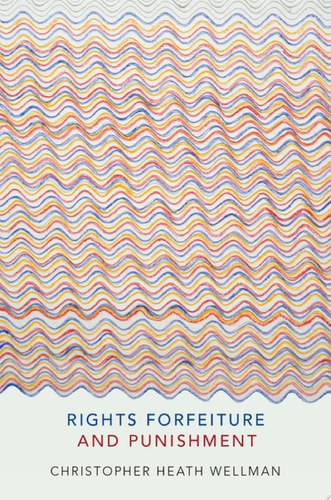
Rights Forfeiture and Punishment
0
0
As an Amazon Associate and affiliate partner, Menrva Books earns from qualifying purchases. Learn more
Author Description
Given that persons typically have a right not to be subjected to the hard treatment of punishment, it would seem natural to conclude that the permissibility of punishment is centrally a question of rights. Despite this, the vast majority of theorists working on punishment focus instead on important aims, such as achieving retributive justice, deterring crime, restoring victims, or expressing society's core values. Wellman contends that these aims may well explain why we should want a properly constructed system of punishment, but none shows why it would be permissible to institute one. Only a rights-based analysis will suffice, because the type of justification we seek for punishment must demonstrate that punishment is permissible, and it would be permissible only if it violated no one's rights. On Wellman's view, punishment is permissible just in case the wrongdoer has forfeited her right against punishment by culpably violating (or at least attempting to violate) the rights of others.After defending rights forfeiture theory against the standard objections, Wellman explains this theory's implications for a number of core issues in criminal law, including the authority of the state, international criminal law, the proper scope of the criminal law and the tort/crime distinction, procedural rights, and the justification of mala prohibita.
Menrva's Summary
THE THESIS
This work investigates the moral permissibility of state punishment by centering the analysis on the concept of rights forfeiture rather than traditional utilitarian or retributive aims. Christopher Heath Wellman, a professor of philosophy, argues that because individuals possess a fundamental right against the hard treatment of punishment, any legitimate system must justify its actions by demonstrating that the offender has forfeited this right. He posits that punishment is only permissible when a wrongdoer has culpably violated the rights of others, thereby nullifying their own immunity against state-imposed sanctions.
THE SCOPE MAP
What You Will Find
- A rights-based framework for justifying criminal punishment
- Defense of forfeiture theory against common philosophical objections
- Applications to state authority, international law, and the tort/crime distinction
Scope Limits
- Does not focus on the practical efficacy of deterrence or rehabilitation strategies
- Does not provide a comprehensive history of penal institutions
THE AUTHORITY PERSPECTIVE
Scholars in legal philosophy recognize this text as a rigorous contribution to the rights-based discourse on penal theory. Readers frequently note the academic density of the prose, which is intended for those already familiar with contemporary debates in criminal law and moral philosophy.
Page Count:
240
Publication Date:
2017-08-01
Publisher:
Oxford University Press
ISBN-10:
019027476X
ISBN-13:
9780190274764
Philosophy
Law
Punishment
Political Philosophy
Justice Administration of
Ethics
Community Tags
Other Editions(4)


Similar Books


Reader Comments
Share Your Thoughts
No comments yet. Be the first to share your thoughts!