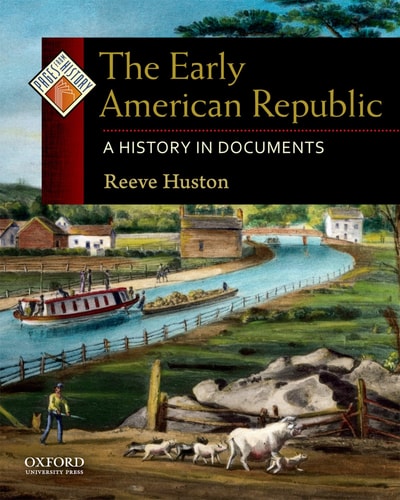
The Early American Republic: A History in Documents
0
0
As an Amazon Associate and affiliate partner, Menrva Books earns from qualifying purchases. Learn more
Author Description
The early years of the American republic witnessed wrenching conflict and change. Northerners created an industrial order, which brought with it troubled relationships at work and within families. White southerners extended plantation slavery while the anti-slavery movement grew above the Mason-Dixon line. In the West, Native Americans battled newly arrived yeomen, entrepreneurs, and planters for control over land. Throughout the young nation numerous groups--African Americans, poor white men, women--fought for full citizenship, while others vigorously opposed their bids for equality. The Mexican-American War (1846-1848) marked the end of the period with violence that prefigured the Civil War.Using such primary sources as diaries, letters, political cartoons, photographs, speeches, engravings, newspaper debates, paintings, and the memoirs of participants, The Early American Republic: A History in Documents recreates the drama of that era. Englishwoman Rebecca Burlend recounts the hardships and victories of her life on the Illinois frontier. In a letter to an ally, Thomas Jefferson explains his Indian policy, while the Native American leader Tecumseh makes his case for Indian unity against white Americans. James Henry Hammond, a wealthy planter, instructs his overseer on how to manage slaves, and Joseph Taper writes his former master about the freedom he enjoys after escaping to Canada. A blackface minstrel tune and Frederick Douglass's account of being beaten up by white ship workers illustrate the emergence of a virulent form of racism. A list of instructions from New York Democratic leaders shows how parties drew ordinary voters into politics, and Congressional speeches reveal the fierce emotions that fueled the sectional crisis. A picture essay explores the complexities of American families in ten group portraits. By weaving these historical documents together, Reeve Huston conveys the challenges and culture of the foundational years of the nation.
Menrva's Summary
THE THESIS
How did the competing social, political, and economic forces of the early American republic shape the nation's trajectory toward the Civil War? Reeve Huston, a scholar of 19th-century American history, compiles a diverse array of primary source materials to examine the tensions inherent in the nation's expansion. By juxtaposing the perspectives of political elites, enslaved individuals, frontier settlers, and marginalized groups, the author constructs a multifaceted view of the era's internal conflicts and structural transformations.
THE SCOPE MAP
What You Will Find
- Primary source documentation including diaries, letters, political cartoons, and speeches from the early 19th century.
- Analysis of the expansion of plantation slavery and the concurrent rise of the anti-slavery movement.
- Examination of the industrialization of the North and its impact on labor and family structures.
- Case studies on the conflict between Native Americans and settlers for control of Western lands.
- Visual evidence through a picture essay detailing the complexities of American family life.
THE AUTHORITY PERSPECTIVE
Historians and educators frequently cite this work as a valuable pedagogical tool for introducing students to the practice of historical inquiry through primary sources. The text is noted for its balanced selection of documents that provide a comprehensive view of the era's social and political volatility.
Page Count:
239
Publication Date:
2010-10-29
Publisher:
Oxford University Press
ISBN-10:
0195338243
ISBN-13:
9780195338249
History
American History
Political History
United States
19th Century
Social History
Primary Sources
Community Tags
Similar Books