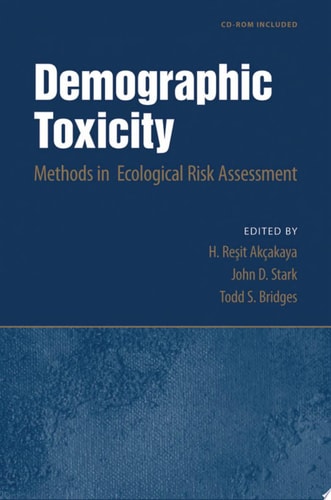
Demographic Toxicity: Methods in Ecological Risk Assessment
0
0
As an Amazon Associate and affiliate partner, Menrva Books earns from qualifying purchases. Learn more
Author Description
This edited volume collects population and metapopulation models for a wide variety of species, focusing on the use of models in population-level risk assessment for toxins. Each chapter of Demographic Toxicity describes the application of a population model to one species, with the aim of demonstrating how various life history characteristics of the species are incorporated into the model, how ecotoxicological impacts are modeled, and how the results of the model has been or can be used in risk assessment. The model in each chapter is implemented in RAMAS software, which uses matrix modeling of population dynamics. RAMAS software is believed to be the most powerful tool ever invented for this task.Demographic Toxicity includes a CD that contains a demo version of the program and the data files for each species. The book explains how to use these specific tools for modeling, analysis, and interpretation of data. Demographic Toxicity provides a major review of current knowledge on population dynamics in different species, representing both terrestrial and aquatic environments.
Menrva's Summary
THE THESIS
This volume investigates how population and metapopulation modeling can be utilized to accurately assess the ecological risks posed by toxic substances. The authors, H. Resit Akcakaya, John D. Stark, and Todd S. Bridges, synthesize current knowledge on population dynamics across diverse terrestrial and aquatic species. By integrating life history characteristics into matrix modeling frameworks, the text provides a structured approach to predicting ecotoxicological impacts and informing environmental risk management strategies.
THE SCOPE MAP
What You Will Find
- Population and metapopulation modeling techniques for various species
- Implementation of RAMAS software for matrix modeling of population dynamics
- Case studies covering both terrestrial and aquatic environmental contexts
- Methodologies for interpreting ecotoxicological data in risk assessment
THE AUTHORITY PERSPECTIVE
Experts recognize this volume as a specialized technical resource for researchers and practitioners in ecotoxicology. Readers frequently note the high level of technical detail and the practical utility of the included software tools for professional risk assessment applications.
Page Count:
288
Publication Date:
2008-04-25
Publisher:
Oxford University Press
ISBN-10:
0195332962
ISBN-13:
9780195332964
Science
Pollution
Ecology
Reference
Biology
Toxicology