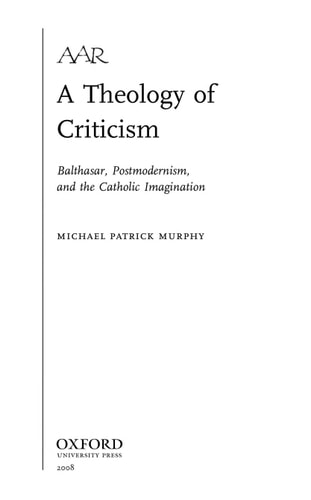
A Theology of Criticism: Balthasar, Postmodernism, and the Catholic Imagination
0
0
As an Amazon Associate and affiliate partner, Menrva Books earns from qualifying purchases. Learn more
Author Description
A number of critics and scholars argue for the notion of a distinctly Catholic variety of imagination, not as a matter of doctrine or even of belief, but rather as an artistic sensibility. They figure the blend of intellectual, emotional, spiritual and ethical assumptions that proceed from Catholic belief constitutes a vision of reality that necessarily informs the artist's imaginative expression. The notion of a Catholic imagination, however, has lacked thematic and theological coherence. To articulate this intuition is to cross the problematic interdisciplinary borders between theology and literature; and, although scholars have developed useful methods for undertaking such interdisciplinary "border-crossings," relatively few have been devoted to a serious examination of the theological aesthetic upon which these other aesthetics might hinge.In A Theology of Criticism, Michael Patrick Murphy proposes a new framework to better define the concept of a Catholic imagination. He explores the many ways in which the theological work of Hans Urs von Balthasar (1905-1988) can provide the model, content, and optic for distinguishing this type of imagination from others. Since Balthasar views art and literature precisely as theologies, Murphy surveys a broad array of poetry, drama, fiction, and film and sets it against central aspects of Balthasar's theological program. In doing so, Murphy seeks to develop a theology of criticism.This interdisciplinary work recovers the legitimate place of a distinct "theological imagination" in critical theory, showing that Balthasar's voice both challenges and complements contemporary developments. Murphy also contends that postmodern interpretive methodology, with its careful critique of entrenched philosophical assumptions and reiterated codes of meaning, is not the threat to theological meaning that many fear. On the contrary, by juxtaposing postmodern critical methodologies against Balthasar's visionary theological range, a space is ma
Menrva's Summary
THE THESIS
This book investigates whether the theological aesthetics of Hans Urs von Balthasar can provide a coherent framework for defining the Catholic imagination within the context of contemporary literary criticism. Michael P. Murphy, a scholar of theology and literature, argues that the Catholic imagination has historically lacked a rigorous theological foundation. By synthesizing Balthasar’s theological program with postmodern interpretive methodologies, Murphy constructs a new critical optic that bridges the divide between religious belief and artistic expression. He posits that postmodern critique, rather than undermining theological meaning, can be effectively utilized to illuminate the visionary depth of the Catholic tradition.
THE SCOPE MAP
What You Will Find
- A comprehensive analysis of Hans Urs von Balthasar’s theological aesthetics as a critical tool.
- A comparative study of postmodern critical theory and traditional theological interpretation.
- An interdisciplinary examination of diverse artistic media, including poetry, drama, fiction, and film.
- A proposed framework for a distinct theology of criticism that integrates spiritual and ethical assumptions.
THE AUTHORITY PERSPECTIVE
Scholars and theologians identify this work as a significant contribution to the intersection of religious studies and literary theory. Readers frequently note the academic density of the prose, which serves as a foundational text for those seeking to reconcile postmodern methodology with classical theological aesthetics.
Page Count:
272
Publication Date:
2008-01-09
Publisher:
Oxford University Press
ISBN-10:
0195333527
ISBN-13:
9780195333527
Philosophy
Religion
Literary Criticism
Theology
Aesthetics
Theology doctrinal
Catholicism
Catholic Church
Community Tags
Similar Books