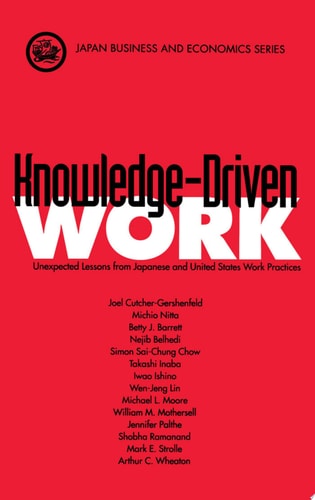
Knowledge-Driven Work: Unexpected Lessons from Japanese and United States Work Practices
0
0
As an Amazon Associate and affiliate partner, Menrva Books earns from qualifying purchases. Learn more
Author Description
Knowledge-Driven Work is a pioneering study of the cross-cultural iffusion of ideas about the organization of work. These ideas, linked with the knowledge of the workforce, are rapidly becoming the primary source of competitive advantage in the world economy. The book provides an in-depth look at eight Japanese-affiliated manufacturing facilities operating in the United States, combined with examinations of their sister facilities in Japan. The authors offer their insights into the complex process by which elements of work systems in one country interact with those in another. They trace the flow of ideas from Japan to the US and other nations, and the beginnings of a reverse diffusion of innovation back to Japan. The authors organize their findings into six categories: the cross-cultural diffusion of work practices, team-based work systems, kaizen and employee involvement, employment security, human resource management, and labor-management relations. Their study of team-based work systems yields a taxonomy of teams and reveals some conflicts between the desire for self-management and the existence of interdependencies. Investigations into kaizen (ongoing incremental improvement) indicate that its emphasis on employee-driven, systematic problem solving makes it a strong counterpoint to the idea of top-down "re-engineering." Looking at employment security, the authors note that while most US managers believe that it restrains managerial flexibility, managers at the firms they observed see it as essential to the flexibility associated with teamwork and kaizen. The study of human resource management practices suggests competitive advantages in diverse, older, unionized, and urban work forces, and emphasizes the importance of wide-ranging training programs in a work system premised on a long-term perspective. The "wildcard" in the work places observed is labor-management relations, the area in which Japanese managers have been least likely to import their ideas.
Menrva's Summary
THE THESIS
This book investigates how the cross-cultural diffusion of work practices between Japan and the United States influences organizational performance and competitive advantage. The authors, a diverse team of researchers, utilize comparative case studies of eight Japanese-affiliated manufacturing facilities in the U.S. and their counterparts in Japan to analyze the integration of work systems. They argue that the successful implementation of knowledge-driven work relies on the complex interplay between local labor-management relations and imported management innovations.
THE SCOPE MAP
What You Will Find
- Comparative analysis of eight Japanese-affiliated manufacturing facilities in the U.S. and Japan.
- A taxonomy of team-based work systems and their associated interdependencies.
- Examination of kaizen as a systematic, employee-driven alternative to top-down re-engineering.
- Analysis of human resource management, employment security, and labor-management relations.
THE AUTHORITY PERSPECTIVE
Experts recognize this work as a significant contribution to the study of international management and the practical application of Japanese work systems in Western contexts. Readers frequently note the academic rigor of the comparative methodology and the nuanced findings regarding the limitations of cross-cultural idea transfer.
Page Count:
208
Publication Date:
1998-01-01
Publisher:
Oxford University Press
ISBN-10:
0195344367
ISBN-13:
9780195344363
Economics
Business
Principles of Management
International business
Management
Manufacturing
Community Tags
Similar Books











Reader Comments
Share Your Thoughts
No comments yet. Be the first to share your thoughts!