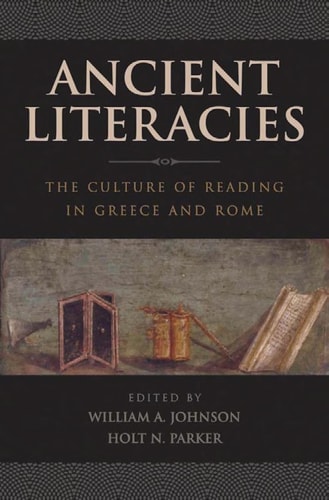
Ancient Literacies: The Culture of Reading in Greece and Rome
0
0
As an Amazon Associate and affiliate partner, Menrva Books earns from qualifying purchases. Learn more
Author Description
Classicists have been slow to take advantage of the important advances in the way that literacy is viewed in other disciplines (including in particular cognitive psychology, socio-linguistics, and socio-anthropology). On the other hand, historians of literacy continue to rely on outdated work by classicists (mostly from the 1960's and 1970's) and have little access to the current reexamination of the ancient evidence. This timely volume attempts to formulate new interesting ways of talking about the entire concept of literacy in the ancient world--literacy not in the sense of whether 10% or 30% of people in the ancient world could read or write, but in the sense of text-oriented events embedded in a particular socio-cultural context. The volume is intended as a forum in which selected leading scholars rethink from the ground up how students of classical antiquity might best approach the question of literacy in the past, and how that investigation might materially intersect with changes in the way that literacy is now viewed in other disciplines. The result will give readers new ways of thinking about specific elements of "literacy" in antiquity, such as the nature of personal libraries, or what it means to be a bookseller in antiquity; new constructionist questions, such as what constitutes reading communities and how they fashion themselves; new takes on the public sphere, such as how literacy intersects with commercialism, or with the use of public spaces, or with the construction of civic identity; new essentialist questions, such as what "book" and "reading" signify in antiquity, why literate cultures develop, or why literate cultures matter. The book derives from a conference (a Semple Symposium held in Cincinnati in April 2006) and includes new work from the most outstanding scholars of literacy in antiquity (e.g., Simon Goldhill, Joseph Farrell, Peter White, and Rosalind Thomas).
Menrva's Summary
THE THESIS
This volume investigates how the concept of literacy in the ancient world can be recontextualized by integrating modern advancements in cognitive psychology, socio-linguistics, and socio-anthropology. Edited by Holt N. Parker and William A. Johnson, the book moves beyond simple statistical debates regarding literacy rates to examine text-oriented events within their specific socio-cultural environments. By synthesizing new scholarly research, the authors provide a framework for understanding how reading and writing functioned as active, formative elements of civic and personal life in antiquity.
THE SCOPE MAP
What You Will Find
- Analysis of the intersection between ancient literacy and modern disciplines like socio-linguistics and cognitive psychology.
- Examination of the role of personal libraries and the professional function of booksellers in the ancient world.
- Exploration of the public sphere, including the relationship between literacy, commercialism, and the construction of civic identity.
- Theoretical inquiries into the significance of the "book" and the development of reading communities in Greece and Rome.
THE AUTHORITY PERSPECTIVE
Scholars and classicists recognize this volume as a critical intervention that updates outdated mid-twentieth-century methodologies regarding ancient literacy. The text is frequently cited for its interdisciplinary approach, making it a foundational resource for students and researchers looking to bridge the gap between classical studies and contemporary social theory.
Page Count:
448
Publication Date:
2009-02-05
Publisher:
Oxford University Press
ISBN-10:
0195340159
ISBN-13:
9780195340150
History
Ancient Greece
Transmission of texts
Sociology
Literacy
Literary Criticism
Education greece
Community Tags
Similar Books