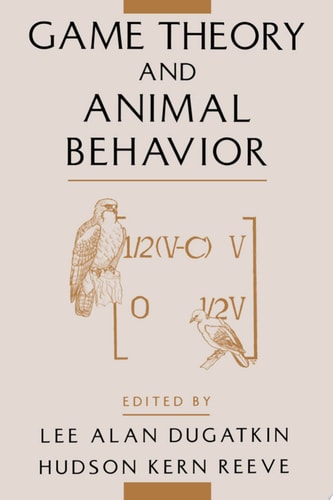
Game Theory and Animal Behavior
0
0
As an Amazon Associate and affiliate partner, Menrva Books earns from qualifying purchases. Learn more
Author Description
Game theory has revolutionized the study of animal behavior. The fundamental principle of evolutionary game theory--that the strategy adopted by one individual depends on the strategies exhibited by others--has proven a powerful tool in uncovering the forces shaping otherwise mysterious behaviors. In this volume, the first since 1982 devoted to evolutionary game theory, leading researchers describe applications of the theory to diverse types of behavior, providing an overview of recent discoveries and a synthesis of current research. The volume begins with a clear introduction to game theory and its explanatory scope. This is followed by a series of chapters on the use of game theory to understand a range of behaviors: social foraging, cooperation, animal contests, communication, reproductive skew and nepotism within groups, sibling rivalry, alternative life-histories, habitat selection, trophic-level interactions, learning, and human social behavior. In addition, the volume includes a discussion of the relations among game theory, optimality, and quantitative genetics, and an assessment of the overall utility of game theory to the study of social behavior. Presented in a manner accessible to anyone interested in animal behavior but not necessarily trained in the mathematics of game theory, the book is intended for a wide audience of undergraduates, graduate students, and professional biologists pursuing the evolutionary analysis of animal behavior.
Menrva's Summary
THE THESIS
This volume investigates how evolutionary game theory serves as a primary analytical framework for understanding the complex social and survival strategies observed in the animal kingdom. Editors Hudson Kern Reeve and Lee Alan Dugatkin compile contributions from leading researchers to demonstrate how individual behavioral strategies are contingent upon the actions of others. The text provides a comprehensive synthesis of research developments since the early 1980s, bridging the gap between mathematical modeling and empirical biological observation.
THE SCOPE MAP
What You Will Find
- Theoretical foundations of evolutionary game theory and its explanatory scope in biology.
- Applications to diverse behaviors including social foraging, cooperation, animal contests, and communication.
- Analysis of reproductive strategies, sibling rivalry, and habitat selection.
- Integration of game theory with quantitative genetics and optimality models.
THE AUTHORITY PERSPECTIVE
Experts recognize this volume as a significant synthesis for those seeking to apply mathematical modeling to biological systems without requiring advanced training in game theory mathematics. The text is frequently cited as a foundational resource for students and professional biologists interested in the evolutionary mechanisms of social behavior.
Page Count:
336
Publication Date:
1998-01-01
Publisher:
Oxford University Press
ISBN-10:
0195350200
ISBN-13:
9780195350203
Science
Mathematics Statistics
Mathematics - General
Nature
Biology
Zoology
Evolutionary Biology
Game theory
Community Tags
Other Editions(2)

Similar Books