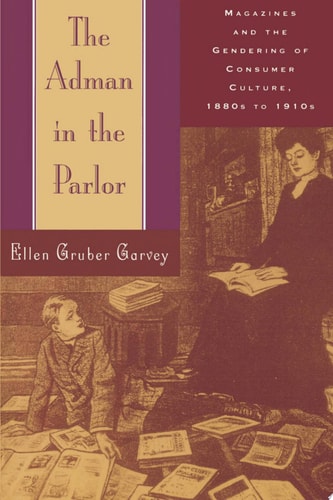
The Adman in the Parlor: Magazines and the Gendering of Consumer Culture, 1880s to 1910s
0
0
As an Amazon Associate and affiliate partner, Menrva Books earns from qualifying purchases. Learn more
Author Description
How did advertising come to seem natural and ordinary to magazine readers by the end of the nineteenth century? The Adman in the Parlor explores readers' interactions with advertising during a period when not only consumption but advertising itself became established as a pleasure. Garvey argues that readers' participation in advertising, rather than top-down dictation by advertisers, made advertizing a central part of American culture. Garvey's analysis interweaves such texts and artifacts as advertising trade journals, magazines addressed to elite, middle class, and poorer readerships, scrapbooks, medical articles, paper dolls, chromolithographed trade cards, and contest rules. She tracks new forms of fictional realism that contained brand name references, courtship stories, and other fictional forms. As magazines became dependant on advertising rather than sales for their revenues, women's magazines led the way in making consumers of readers through the interplay of fiction, editorials, and advertising. General magazines, too, saw little conflict between these different interests. Instead, advertising and fiction came to act on one another in complex, unexpected ways. Magazine stories illustrated the multiple desires and social meanings embodied in the purchase of a product. Garvey takes the bicycle as a case study, and tracks how magazines mediated among competing medical, commercial, and feminist discourses to produce an alluring and unthreatening model of women bicycling in their stories. Advertising formed the national vocabulary. At once invisible, familiar, and intrusive, advertising both shaped fiction of the period and was shaped by it. The Adman in the Parlor unearths the lively conversations among writers and advertisers about the new prevalence of advertising for mass-produced, nationally distributed products.
Menrva's Summary
THE THESIS
This work investigates how advertising transitioned from a novel commercial practice to an integrated, naturalized component of American domestic life between the 1880s and 1910s. Ellen Gruber Garvey, a scholar of American literature and culture, utilizes a diverse array of primary sources—ranging from trade journals and scrapbooks to popular magazines—to argue that consumers actively participated in the construction of advertising culture. By examining the symbiotic relationship between editorial content and commercial messaging, Garvey demonstrates how readers and advertisers co-created the modern consumer identity.
THE SCOPE MAP
What You Will Find
- Analysis of the shift in magazine revenue models from subscription-based to advertising-dependent systems.
- Examination of diverse media artifacts including chromolithographed trade cards, contest rules, and medical articles.
- A focused case study on the cultural mediation of the bicycle as a symbol of feminist and commercial discourse.
- Exploration of how fictional narratives in magazines incorporated brand-name references to normalize consumer behavior.
THE AUTHORITY PERSPECTIVE
Scholars in media history and American studies frequently cite this text for its nuanced approach to the intersection of gender, literature, and commerce. Experts highlight the book as a foundational resource for understanding the early development of mass-market advertising strategies.
Page Count:
246
Publication Date:
1996-01-01
Publisher:
Oxford University Press
ISBN-10:
0195355318
ISBN-13:
9780195355314
History
Criticism history
American History
Consumers
Short Stories
Graphic ArtsCommunicationsDesign
Professional Career & Trade
Advertising
Media Studies
English & College Success
Periodicals publishing
Gender Studies
English
Community Tags
Similar Books