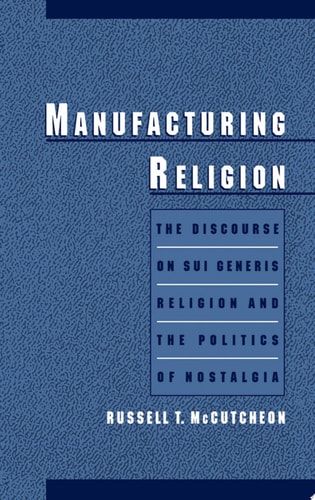
Manufacturing Religion: The Discourse on Sui Generis Religion and the Politics of Nostalgia: Discourse of Sui Generis Religion and the Politics of Nostalgia
0
0
As an Amazon Associate and affiliate partner, Menrva Books earns from qualifying purchases. Learn more
Author Description
In This New Book, Author Russell Mccutcheon Offers A Powerful Critique Of Traditional Scholarship On Religion, Focusing On Multiple Interrelated Targets. Most Prominent Among These Are The History Of Religions As A Discipline; Mircea Eliade, One Of The Founders Of The Modern Discipline; Recent Scholarship On Eliade's Life And Politics; Contemporary Textbooks On World Religions; And The Oft-repeated Bromide That Religion Is A Sui Generis Phenomenon. Mccutcheon Skillfully Analyzes The Ideological Basis For And Service Of The Sui Generis Argument, Demonstrating That It Has Been Used To Constitute The Field's Object Of Study In A Form That Is Ahistoric, Apolitical, Fetishized, And Sacrosanct. As Such, He Charges, It Has Helped To Create Departments, Jobs, And Publication Outlets For Those Who Are Comfortable With Such A Suspect Construction, While Establishing A Disciplinary Ethos Of Astounding Theoretical Naivete And A Body Of Scholarship To Match. Surveying The Textbooks Available For Introductory Courses In Comparative Religion, The Author Finds That They Uniformly Adopt The Sui Generis Line And All That Comes With It. As A Result, He Argues, They Are Not Just Uncritical (which Helps Keep Them Popular Among The Audiences For Which They Are Intended, But Badly Disserve), But Actively Inhibit The Emergence Of Critical Perspectives And Capacities. And On The Geo-political Scale, He Contends, The Study Of Religion As An Ahistorical Category Participates In A Larger System Of Political Domination And Economic And Cultural Imperialism.
Menrva's Summary
THE THESIS
This work investigates the ideological functions and political implications of defining religion as a sui generis, or unique and autonomous, phenomenon within academic discourse. Russell T. McCutcheon, a scholar of religion, utilizes critical theory to examine how the discipline of religious studies has historically constructed its object of study to remain ahistorical and apolitical. By analyzing the influence of figures like Mircea Eliade and the content of contemporary introductory textbooks, the author argues that the sui generis claim serves to insulate the field from critical inquiry while reinforcing broader systems of cultural and political power.
THE SCOPE MAP
What You Will Find
- A critical analysis of the history of religions as an academic discipline.
- An examination of the ideological foundations of the sui generis argument.
- A survey of common introductory textbooks used in comparative religion courses.
- An exploration of the intersection between religious studies and geopolitical imperialism.
THE AUTHORITY PERSPECTIVE
Scholars frequently cite this text as a foundational critique within the critical theory of religion, noting its rigorous challenge to traditional phenomenological approaches. Academics often highlight the book's dense theoretical framework as a necessary, if demanding, intervention in the methodology of religious studies.
Page Count:
272
Publication Date:
1997-01-01
Publisher:
Oxford University Press
ISBN-10:
0195355687
ISBN-13:
9780195355680
Religion
Philosophy
History
Sociology
Kindle Store
Kindle eBooks
Academic
History of Religions
Categories
Community Tags
Similar Books