American Mobbing, 1828-1861: Toward Civil War
0
0
As an Amazon Associate and affiliate partner, Menrva Books earns from qualifying purchases. Learn more
Author Description
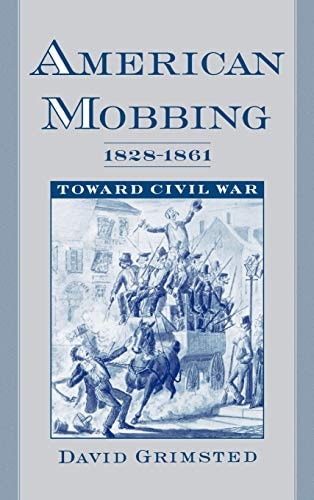
American Mobbing, 1828-1861: Toward Civil War is a comprehensive history of mob violence related to sectional issues in antebellum America. David Grimsted argues that, though the issue of slavery provoked riots in both the North and the South, the riots produced two different reactions from authorities. In the South, riots against suspected abolitionists and slave insurrectionists were widely tolerated as a means of quelling anti-slavery sentiment. In the North, both pro-slavery riots attacking abolitionists and anti-slavery riots in support of fugitive slaves provoked reluctant but often effective riot suppression. Hundreds died in riots in both regions, but in the North, most deaths were caused by authorities, while in the South more than 90 percent of deaths were caused by the mobs themselves. These two divergent systems of violence led to two distinct public responses. In the South, widespread rioting quelled public and private questioning of slavery; in the North, the milder, more controlled riots generally encouraged sympathy for the anti-slavery movement. Grimsted demonstrates that in these two distinct reactions to mob violence, we can see major origins of the social split that infiltrated politics and political rioting and that ultimately led to the Civil War.
Menrva's Summary
THE THESIS
This work investigates how divergent patterns of mob violence in the North and South during the antebellum period served as a catalyst for the social and political polarization that culminated in the American Civil War. David Grimsted, a historian specializing in American cultural and social history, utilizes an extensive analysis of riot records and public responses to demonstrate how regional attitudes toward civil disorder shaped the national trajectory. He argues that the South utilized mob violence as a tool to suppress anti-slavery discourse, while the North’s more restrained, state-managed approach to riots inadvertently fostered sympathy for the abolitionist cause. By contrasting these two systems of violence, the book provides a framework for understanding the breakdown of national unity.
THE SCOPE MAP
What You Will Find
- A detailed examination of mob violence in the United States between 1828 and 1861.
- Comparative analysis of riot suppression tactics employed by Northern versus Southern authorities.
- Statistical data regarding mortality rates and the primary instigators of civil unrest in both regions.
- An exploration of how regional reactions to public disorder influenced political discourse and sectional identity.
THE AUTHORITY PERSPECTIVE
Historians and scholars of the antebellum era frequently cite this text as a foundational study on the intersection of civil disorder and political polarization. Readers often note the rigorous use of primary source data to support the author's argument regarding the distinct regional cultures of violence.
Page Count:
400
Publication Date:
1998-01-01
Publisher:
Oxford University Press
ISBN-10:
0195353668
ISBN-13:
9780195353662
History
American History
United States
Social History
Civil War
Political History
Antebellum
Violence