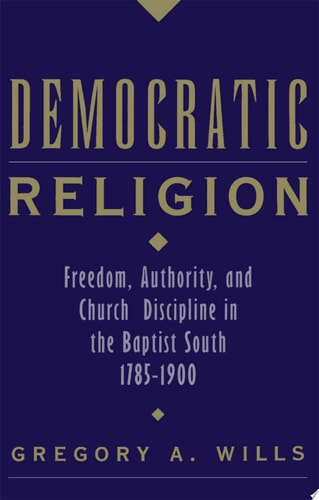
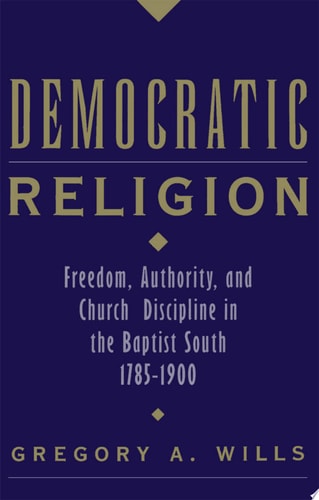
Democratic Religion: Freedom, Authority, and Church Discipline in the Baptist South, 1785-1900
0
0
As an Amazon Associate and affiliate partner, Menrva Books earns from qualifying purchases. Learn more
Author Description
Democracy has not always fostered anti-authoritarian individualism. No American denomination identified itself more closely with the nation's democratic ideal than the Baptists. Most antebellum southern Baptist churches allowed women and slaves to vote on membership matters and preferred populist preachers who addressed their appeals to the common person. Paradoxically, no denomination wielded religious authority as zealously as the Baptists. Between 1785 and 1860 they ritually (and democratically) excommunicated forty to fifty thousand church members in Georgia alone. Wills demonstrates how a denomination of freedom-loving individualists came to embrace an exclusivist spirituality - a spirituality that continues to shape Southern Baptist churches in contemporary conflicts between moderates who urge tolerance and conservatives who require belief in scriptural inerrancy. Wills's analysis advances our understanding of the interaction between democracy and religious authority, and will appeal to scholars of American religion, culture, and history, as well as to Baptist observers.
Menrva's Summary
THE THESIS
This book investigates the paradoxical relationship between democratic ideals and the exercise of strict religious authority within Southern Baptist churches from 1785 to 1900. Gregory A. Wills, a scholar of American religious history, utilizes extensive archival research to examine how a denomination defined by populist, individualistic freedom simultaneously maintained rigorous standards of church discipline. He argues that this commitment to exclusivist spirituality was not a contradiction of their democratic nature, but rather a fundamental component of their communal identity that continues to influence modern ecclesiastical conflicts.
THE SCOPE MAP
What You Will Find
- Historical analysis of church discipline practices in the American South between 1785 and 1900.
- Examination of the role of congregational voting rights for women and enslaved members.
- Quantitative data regarding excommunication rates in Georgia during the antebellum period.
- Exploration of the theological transition from populist individualism to modern debates over scriptural inerrancy.
THE AUTHORITY PERSPECTIVE
Scholars of American religious history recognize this work as a foundational text for understanding the internal governance of Southern Baptist life. Readers frequently note the academic rigor of the archival research and the clarity with which the author connects nineteenth-century disciplinary practices to contemporary denominational tensions.
Page Count:
208
Publication Date:
1996-01-01
Publisher:
Oxford University Press, Incorporated
ISBN-10:
019535589X
ISBN-13:
9780195355895
History
Religion
Religious Aspects
Church History
American History
Christianity
Baptists history
Southern Baptist Convention
Sociology of Religion
Community Tags
Other Editions(2)
Similar Books