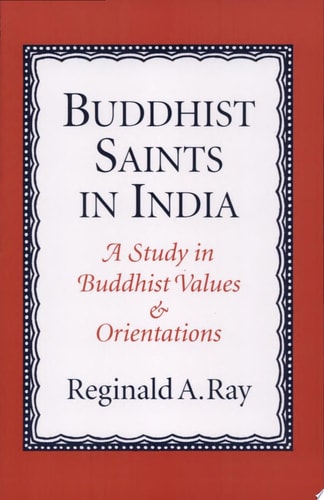
Buddhist Saints in India: A Study in Buddhist Values and Orientations
0
0
As an Amazon Associate and affiliate partner, Menrva Books earns from qualifying purchases. Learn more
Author Description
The issue of saints is a difficult and complicated problem in buddhology. This study is the first comprehensive examination of the figure of the Buddhist saint in a wide range of Indian Buddhist evidence. Drawing on an extensive variety of sources, Ray seeks to identify the prototypical Buddhist saint as a "renunciant of the forest." This classical type, Ray argues, provides the presupposition for, and informs the different major Buddhist saintly types and subtypes, including the buddha, pratyekabuddha, arhant, and bodhisattva. Discussing the nature, dynamics, and history of Buddhist hagiography, Ray surveys the ascetic codes, conventions, and traditions of Buddhist saints, and the cults both of living saints and of those who have "passed beyond." He traces the role of the saints in Indian Buddhist history, particularly at the times of Buddhist origins and the formation of the Mahayana. Calling for a reconceptualization of Indian Buddhist history that takes into account the essential role played by the saints of the forest, Ray proposes a new three-fold model of Buddhism, that adds the forest renunciant to the well-known figures of the Buddhist monastic and layperson. Of primary concern to scholars of Buddhism, Indian religions, Asian studies, and religious studies, Buddhist Saints in India will also interest those who study hagiography.
Menrva's Summary
THE THESIS
This study investigates the historical and religious significance of the Buddhist saint figure within the context of Indian Buddhist traditions. Reginald A. Ray, a scholar of Buddhist studies, utilizes a vast array of primary sources and hagiographical evidence to argue that the 'renunciant of the forest' serves as the foundational archetype for all subsequent saintly types in Buddhism. By re-evaluating the historical development of the religion, Ray proposes a tripartite model that integrates the forest renunciant alongside the traditional monastic and layperson figures to provide a more accurate historical framework.
THE SCOPE MAP
What You Will Find
- A comprehensive analysis of major saintly types including the buddha, pratyekabuddha, arhant, and bodhisattva.
- An examination of ascetic codes, traditions, and the cults surrounding both living and deceased saints.
- A historical survey covering the origins of Buddhism and the subsequent formation of the Mahayana tradition.
- A proposed three-fold model of Indian Buddhism that redefines the role of the forest renunciant in religious history.
THE AUTHORITY PERSPECTIVE
Scholars frequently cite this work as a foundational text for understanding the hagiographical and ascetic dimensions of Indian Buddhism. Experts highlight the density of the research and its significant contribution to the academic discourse on Buddhist history and religious values.
Page Count:
528
Publication Date:
1999-01-01
Publisher:
Oxford University Press
ISBN-10:
0195350618
ISBN-13:
9780195350616
Philosophy
History
Religion
Asian Studies
Buddhism
Community Tags
Similar Books