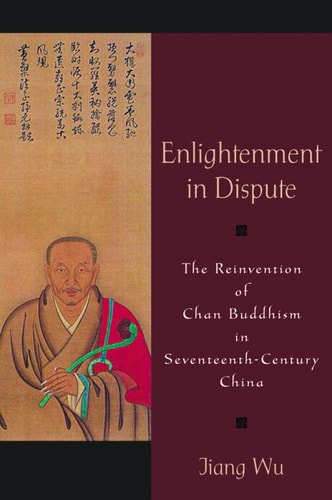
Enlightenment in Dispute: The Reinvention of Chan Buddhism in Seventeenth-Century China
0
0
As an Amazon Associate and affiliate partner, Menrva Books earns from qualifying purchases. Learn more
Author Description
Enlightenment in Dispute is the first comprehensive study of the revival of Chan Buddhism in seventeenth-century China. Focusing on the evolution of a series of controversies about Chan enlightenment, Jiang Wu describes the process by which Chan reemerged as the most prominent Buddhist establishment of the time. He investigates the development of Chan Buddhism in the seventeenth century, focusing on controversies involving issues such as correct practice and lines of lineage. In this way, he shows how the Chan revival reshaped Chinese Buddhism in late imperial China. Situating these controversies alongside major events of the fateful Ming-Qing transition, Wu shows how the rise and fall of Chan Buddhism was conditioned by social changes in the seventeenth century.
Menrva's Summary
THE THESIS
This work investigates how the revival of Chan Buddhism in seventeenth-century China was fundamentally shaped by intense doctrinal disputes and the broader socio-political instability of the Ming-Qing transition. Jiang Wu, a scholar of Chinese Buddhism, utilizes a rigorous historical framework to analyze how Chan institutions navigated challenges regarding lineage authenticity and meditative practice. By examining these internal conflicts, the author argues that the institutionalization of Chan was not a static preservation of tradition but a dynamic reinvention necessitated by the changing landscape of late imperial China.
THE SCOPE MAP
What You Will Find
- Analysis of seventeenth-century Chan Buddhist controversies regarding enlightenment and lineage.
- Historical context of the Ming-Qing transition and its impact on religious institutions.
- Examination of the institutionalization process of Chan Buddhism.
Scope Limits
- The study focuses primarily on the seventeenth century and does not provide a comprehensive history of Chan Buddhism across all Chinese dynasties.
- The text prioritizes institutional and doctrinal history over the personal spiritual experiences of individual practitioners.
THE AUTHORITY PERSPECTIVE
Scholars frequently cite this text as a foundational study for understanding the institutional evolution of Buddhism during the Ming-Qing period. Readers often note the academic density of the prose, which is tailored for researchers and students of East Asian religious history.
Page Count:
478
Publication Date:
2008-01-01
Publisher:
Oxford University Press
ISBN-10:
0190450479
ISBN-13:
9780190450472
Religion
History
Philosophy
Buddhism china
Asian Studies
Cultural History
Asian History
Zen Buddhism
Buddhism
Community Tags
Similar Books