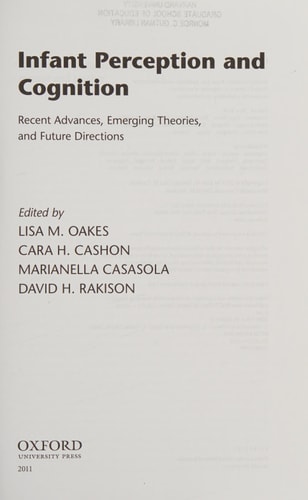
Infant Perception and Cognition: Recent Advances, Emerging Theories, and Future Directions
0
0
As an Amazon Associate and affiliate partner, Menrva Books earns from qualifying purchases. Learn more
Author Description
The cognitive revolution in the 1950s and 1960s led researchers to view the human mind--like a computer--as an information-processing system that encodes, represents, and stores information and is constrained by limits on hardware (the brain) and software (learning strategies and rules). The emergence of new behavioral, computational, and neuroscience methodologies, has deeply expanded psychologists' understanding of the workings of the infant, child, and adult mind. One result is that research has focused on mechanisms of change, over developmental time, in the information-processing mind.In this book, Lisa Oakes, Cara Cashon, Marianella Casasola, and David Rakison bring together the recent findings and theories about the origins and early development of the information-processing mind, and provide insight into the future directions in the study of infant perception and cognition. The contributors represent a wide-range of research areas in the study of infant perception and cognition, who emphasize the use of diverse methodological techniques to address key questions about development. Their chapters demonstrate how the combination of historical perspectives on the information-processing approach to cognition and recent advances in behavioral, computational, and neuroscience approaches to cognition has contributed to our understanding of how abilities ranging from visual attention to face processing to object categorization have developed during infancy. Across this broad range of topics, it is clear that much of our modern understanding of infant perceptual and cognitive development emerges from the foundation of classic information-processing models of development, such as that of Leslie B. Cohen (1991). The recent advances illustrated in this book show how researchers have built on this foundation to uncover the mechanisms that drive developmental change.
Menrva's Summary
THE THESIS
This volume investigates the mechanisms of developmental change in the infant mind by synthesizing historical information-processing models with contemporary behavioral, computational, and neuroscience methodologies. The editors, all established researchers in developmental psychology, curate a collection of chapters that examine how early cognitive abilities—such as visual attention, face processing, and object categorization—emerge and evolve. By bridging classic theoretical frameworks with modern empirical data, the authors provide a comprehensive overview of how the infant mind functions as an information-processing system.
THE SCOPE MAP
What You Will Find
- Analysis of information-processing models in developmental psychology.
- Integration of behavioral, computational, and neuroscience research techniques.
- Examination of specific cognitive domains including visual attention, face processing, and object categorization.
- Discussion of future research trajectories in the study of infant perception and cognition.
THE AUTHORITY PERSPECTIVE
Experts identify this text as a significant resource for understanding the evolution of developmental research methodologies. Scholars frequently note the academic density of the prose, making it a valuable reference for graduate students and researchers in the field of cognitive development.
Page Count:
312
Publication Date:
2010-10-14
Publisher:
Oxford University Press
ISBN-10:
0195366700
ISBN-13:
9780195366709
Psychology
Developmental Psychology
Academic
Neuroscience
Community Tags
Similar Books












Reader Comments
Share Your Thoughts
No comments yet. Be the first to share your thoughts!