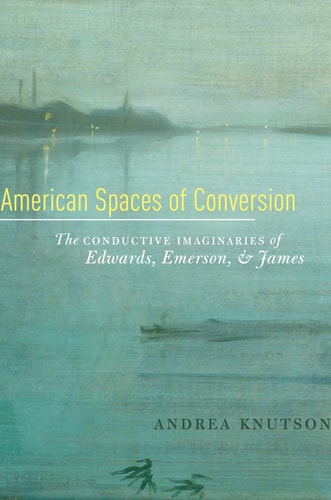
American Spaces of Conversion: The Conductive Imaginaries of Edwards, Emerson, and James
0
0
As an Amazon Associate and affiliate partner, Menrva Books earns from qualifying purchases. Learn more
Author Description
The religious precepts of the Puritans continued to affect intellectual life in the U.S. long after the immigrants arrived at Massachusetts Bay, circulating through New England culture well into the eighteenth and nineteenth centuries. Using three emblematic figures--Jonathan Edwards, Ralph Waldo Emerson, and William James--American Spaces of Conversion examines how the Puritan legacy, especially the concept of conversion, shaped developments in American literature, theology, and pragmatist philosophy.Knutson grounds her study with the testimonies collected by the Puritan minister Thomas Shepard, which reveal an active pursuit of belief occurring at the intersection of perception, intellection, affection, and doctrine. This pursuit of belief, codified in the morphology of conversion, was originally undertaken by the Puritans as a way to conceptualize redemption in a fallen state. It established the epistemological contours for what Edwards, Emerson, and James would theorize as a conductive imaginary-consciousness, a state both receptive and active, as a force responsible for translating the effects of experience and generating original relations with self, community, and God.With an interdisciplinary approach that combines religion, literature, and philosophy, Knutson demonstrates how the triad of writers discussed here "ministered" to their audiences, encouraging the attachment of new meaning to ordinary contexts in a continual effort toward regeneration.
Menrva's Summary
THE THESIS
This work investigates how the Puritan concept of conversion evolved into a foundational intellectual framework that shaped American literature, theology, and pragmatist philosophy. Andrea Knutson, an academic scholar, utilizes primary source testimonies from the Puritan minister Thomas Shepard to trace the development of the 'conductive imaginary.' By analyzing the writings of Jonathan Edwards, Ralph Waldo Emerson, and William James, she argues that these figures adapted Puritan morphology to conceptualize human consciousness as a force that actively translates experience into new meaning.
THE SCOPE MAP
What You Will Find
- Historical analysis of Puritan religious precepts and their influence on New England intellectual culture.
- Examination of the 'conductive imaginary' as a state of consciousness that is both receptive and active.
- Integration of primary source testimonies from Thomas Shepard regarding the pursuit of belief.
- Interdisciplinary study connecting theology, literary theory, and pragmatist philosophy.
THE AUTHORITY PERSPECTIVE
Scholars recognize this text as a rigorous interdisciplinary study that bridges the gap between early American religious history and later philosophical developments. Readers frequently note the academic density of the prose, which is tailored for those interested in the evolution of American intellectual thought.
Page Count:
200
Publication Date:
2010-12-03
Publisher:
Oxford University Press
ISBN-10:
0195370929
ISBN-13:
9780195370928
Philosophy
History
Religion
Theology
Puritans
Literary Criticism
American Studies
Community Tags
Similar Books