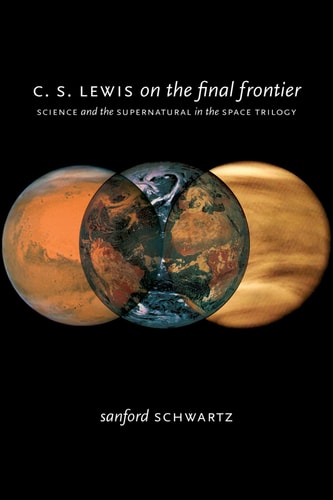
C. S. Lewis on the Final Frontier: Science and the Supernatural in the Space Trilogy
0
0
As an Amazon Associate and affiliate partner, Menrva Books earns from qualifying purchases. Learn more
Author Description
C.S. Lewis's celebrated Space Trilogy - Out of the Silent Planet, Perelandra, and That Hideous Strength - was completed over sixty years ago and has remained in print ever since. In this study, Sanford Schwartz offers a new reading that challenges the conventional view of these novels as portraying a clear-cut struggle between a pre-modern cosmology and the modern scientific paradigm that supplanted it. Schwartz situates Lewis's work in the context of modern intellectual, cultural, and political history. He shows that Lewis does not simply dismiss the modern "evolutionary model," but discriminates carefully among different kinds of evolutionary theory-"mechanistic" in Out of the Silent Planet, "vitalist" in Perelandra, and "spiritual" in That Hideous Strength-and their distinctive views of human nature, society, and religious belief. Schwartz also shows that in each book the conflict between Christian and "developmental" viewpoints is far more complex than is generally assumed. In line with the Augustinian understanding that "bad things are good things perverted," Lewis constructs each of his three "beatific" communities-the "unfallen" worlds on Mars and Venus and the terrestrial remnant at St. Anne's-not as the sheer antithesis but rather as the transfiguration or "raising up" of the particular evolutionary doctrine that is targeted in the novel. In this respect, Lewis is more deeply engaged with the main currents of modern thought than his own self-styled image as an intellectual "dinosaur" might lead us to believe. He is also far more prepared to explore the possibilities for reshaping the evolutionary model in a manner that is simultaneously compatible with traditional Christian doctrine and committed to addressing the distinctive concerns of modern existence. C.S. Lewis on the Final Frontier highlights the enduring relevance of Lewis's fiction to contemporary concerns on a wide variety of issues, including the ethical problems surrounding bio-technology.
Menrva's Summary
THE THESIS
This study investigates whether C.S. Lewis’s Space Trilogy functions as a simple rejection of modern science or as a nuanced engagement with evolutionary theory. Sanford Schwartz, a scholar of modern intellectual history, argues that Lewis does not merely dismiss scientific paradigms but instead critically differentiates between mechanistic, vitalist, and spiritual evolutionary models. By situating the trilogy within the broader context of twentieth-century thought, Schwartz demonstrates how Lewis attempts to reconcile traditional Christian doctrine with the developmental frameworks of his era.
THE SCOPE MAP
What You Will Find
- Analysis of the three novels: Out of the Silent Planet, Perelandra, and That Hideous Strength.
- Examination of evolutionary theories including mechanistic, vitalist, and spiritual models.
- Application of Augustinian theology to the construction of fictional communities.
- Discussion of contemporary ethical issues such as bio-technology and modern political history.
THE AUTHORITY PERSPECTIVE
Scholars and readers of Lewis frequently note that this text provides a sophisticated corrective to the common perception of Lewis as a purely anti-modern thinker. It is regarded as a valuable resource for those interested in the intersection of mid-century science fiction and theological discourse.
Page Count:
256
Publication Date:
2009-07-02
Publisher:
Oxford University Press
ISBN-10:
019537472X
ISBN-13:
9780195374728
Philosophy
Science Fiction
Religion
Cultural History
Theology
Literary Criticism
Community Tags
Similar Books



Reader Comments
Share Your Thoughts
No comments yet. Be the first to share your thoughts!