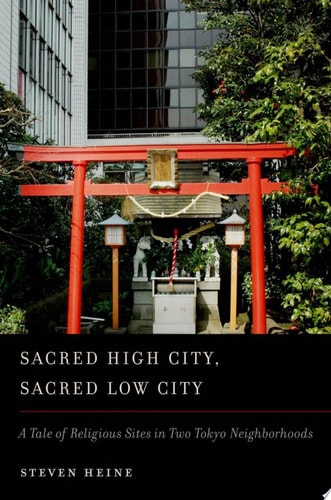
Sacred High City, Sacred Low City: A Tale of Religious Sites in Two Tokyo Neighborhoods
0
0
As an Amazon Associate and affiliate partner, Menrva Books earns from qualifying purchases. Learn more
Author Description
In Sacred High City, Sacred Low City, Steven Heine argues that lived religion in Japan functions as an integral part of daily life; any apparent lack of interest masks a fundamental commitment to participating regularly in diverse, though diffused, religious practices. The book uses case studies of religious sites at two representative but contrasting Tokyo neighborhoods as a basis for reflecting on this apparently contradictory quality. In what ways does Japan continue to carry on and adapt tradition, and to what extent has modern secular society lost touch with the traditional elements of religion? Or does Japanese religiosity reflect another, possibly postmodern, alternative beyond the dichotomy of sacred and secular, in which religious differences as well as a seeming indifference to religion are encompassed as part of a contemporary lifestyle?
Menrva's Summary
THE THESIS
This book investigates whether the apparent secularism of modern Japan masks a persistent, diffused form of religious practice integrated into daily life. Steven Heine, a scholar of Japanese religion and culture, utilizes his expertise to analyze the intersection of tradition and modernity. He argues that Japanese religiosity may represent a postmodern alternative that transcends the traditional binary of sacred versus secular, suggesting that religious participation is embedded within contemporary lifestyle choices.
THE SCOPE MAP
What You Will Find
- Comparative analysis of religious sites in two distinct Tokyo neighborhoods
- Examination of lived religion as a daily practice
- Theoretical framework regarding the intersection of tradition and secular society
Scope Limits
- Does not provide an exhaustive survey of all religious institutions in Japan
- Focuses primarily on the Tokyo metropolitan context rather than rural religious practices
THE AUTHORITY PERSPECTIVE
Experts recognize this work as a nuanced contribution to the study of contemporary Japanese religious behavior. Scholars frequently note that the text provides a clear methodology for observing how traditional practices persist within highly modernized urban environments.
Page Count:
230
Publication Date:
2011-01-01
Publisher:
Oxford University Press
ISBN-10:
019045265X
ISBN-13:
9780190452650
Religion
History
Japan Studies
Buddhism
Urban Studies
Religion and sociology
Sociology
Asian History
Sacred Space
Social Life
Japan religion
Cultural History
Community Tags
Similar Books