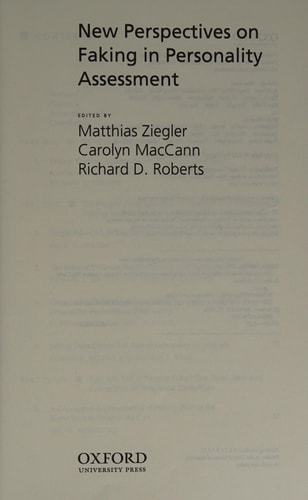
New Perspectives on Faking in Personality Assessments
0
0
As an Amazon Associate and affiliate partner, Menrva Books earns from qualifying purchases. Learn more
Author Description
In this volume, a diverse group of world experts in personality assessment showcase a range of different viewpoints on response distortion. Contributors consider what it means to "fake" a personality assessment, why and how people try to obtain particular scores on personality tests, and what types of tests people can successfully manipulate. The authors present and discuss the usefulness of a range of traditional and cutting-edge methods for detecting and controlling the practice of faking. These methods include social desirability (lie) scales, warnings, affective neutralization, unidimensional and multidimensional pairwise preferences, decision trees, linguistic analysis, situational measures, and methods based on item response theory. The wide range of viewpoints presented in this book are then summarized, synthesized, and evaluated. The authors make practical recommendations and suggest areas for future research. Anyone who wonders whether people exaggerate or lie outright on personality tests -- or questions what psychologists can and should do about it -- will find in this book stimulating questions and useful answers.
Menrva's Summary
THE THESIS
This volume investigates the complex phenomenon of response distortion in personality testing and evaluates strategies for detecting and mitigating such behavior. The editors, Carolyn MacCann, Matthias Ziegler, and Richard L. Roberts, curate contributions from international experts to examine the motivations behind faking and the efficacy of various psychometric interventions. The text synthesizes diverse theoretical perspectives to provide a comprehensive overview of how personality assessments can be protected against intentional manipulation.
THE SCOPE MAP
What You Will Find
- Analysis of traditional and modern methods for detecting response distortion including lie scales and linguistic analysis.
- Evaluation of item response theory and decision tree models in the context of test security.
- Discussion of situational measures and affective neutralization techniques.
- Practical recommendations for researchers and practitioners to improve the validity of personality assessments.
THE AUTHORITY PERSPECTIVE
Experts recognize this volume as a comprehensive resource for understanding the current state of research on response distortion in psychometrics. The text is noted for its academic rigor and serves as a primary reference for professionals seeking to address the challenges of faking in personality testing.
Page Count:
384
Publication Date:
2011-01-01
Publisher:
Oxford University Press
ISBN-10:
0195387473
ISBN-13:
9780195387476
Psychology
Personality Assessment
Research Methods
Psychometrics
Academic
Community Tags
Similar Books