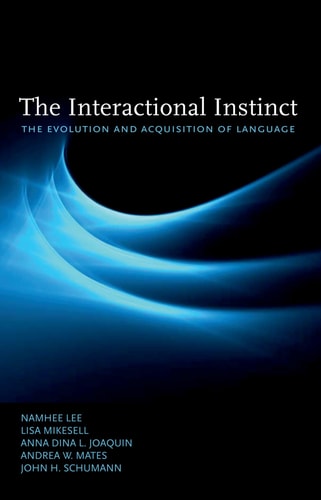
The Interactional Instinct: The Evolution and Acquisition of Language
0
0
As an Amazon Associate and affiliate partner, Menrva Books earns from qualifying purchases. Learn more
Author Description
The Interactional Instinct explores the evolution of language from the theoretical view that language could have emerged without a biologically instantiated Universal Grammar. In the first part of the book, the authors speculate that a hominid group with a lexicon of about 600 words could combine these items to make larger meanings. Combinations that are successfully produced, comprehended, and learned become part of the language. Any combination that is incompatible with human mental capacities is abandoned. The authors argue for the emergence of language structure through interaction constrained by human psychology and physiology.In the second part of the book, the authors argue that language acquisition is based on an "interactional instinct" that emotionally entrains the infant on caregivers. This relationship provides children with a motivational and attentional mechanism that ensures their acquisition of language. In adult second language acquisition, the interactional instinct is no longer operating, but in some individuals with sufficient aptitude and motivation, successful second-language acquisition can be achieved.The Interactional Instinct presents a theory of language based on linguistic, evolutionary, and biological evidence indicating that language is a culturally inherited artifact that requires no a priori hard wiring of linguistic knowledge.
Menrva's Summary
THE THESIS
This book investigates whether language structure can emerge from social interaction and human cognitive constraints rather than an innate, biologically hard-wired Universal Grammar. The authors, a multidisciplinary team of linguists and researchers, synthesize evidence from evolutionary biology, psychology, and linguistic theory to propose that language is a culturally inherited artifact. They argue that language evolves through successful communicative combinations that align with human mental and physiological capacities, rather than through pre-programmed linguistic structures.
THE SCOPE MAP
What You Will Find
- A theoretical framework for language emergence based on a limited ancestral lexicon of approximately 600 words.
- Analysis of how human psychology and physiology act as constraints on the development of linguistic structure.
- Examination of the interactional instinct as a primary motivational mechanism for infant language acquisition.
- Comparative study of first language acquisition versus adult second language acquisition processes.
THE AUTHORITY PERSPECTIVE
Experts recognize this work as a significant contribution to functionalist and usage-based linguistic theories. Readers frequently note the academic density of the prose, which requires a foundational understanding of cognitive science and evolutionary theory to fully grasp the authors' arguments.
Page Count:
248
Publication Date:
2009-05-21
Publisher:
Oxford University Press
ISBN-10:
0195384245
ISBN-13:
9780195384246
Psychology
Linguistics
Evolutionary Biology
Community Tags
Similar Books