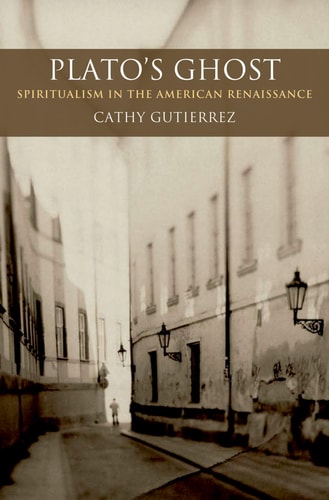
Plato's Ghost: Spiritualism in the American Renaissance
0
0
As an Amazon Associate and affiliate partner, Menrva Books earns from qualifying purchases. Learn more
Author Description
In its day, spiritualism brought hundreds of thousands of Americans to séance tables and trance lectures. It has alternately been ridiculed as the apogee of fatuous credulity and hailed as a feminist movement. Its tricks have been exposed, its charlatans unmasked, and its heroes' names lost to posterity. In its day, however, its leaders were household names and politicians worried about capturing the Spiritualist vote. Cathy Gutierrez places Spiritualism in the context of the 19th-century American Renaissance. Although this epithet usually signifies the sudden blossoming of American letters, Gutierrez points to its original meaning: a cultural imagination enraptured with the past and the classics in particular, accompanied by a cultural efflorescence. Spiritualism, she contends, was the religious articulation of the American Renaissance, and the ramifications of looking backward for advice about the present were far-reaching. The Spiritualist movement, says Gutierrez, was a 'renaissance of the Renaissance,' a culture in love with history as much as it trumpeted progress and futurity, and an expression of what constituted religious hope among burgeoning technology and colonialism. Rejecting Christian ideas about salvation, Spiritualists embraced Platonic and Neoplatonic ideas. Humans were shot through with the divine, rather than seen as helpless and inexorably corrupt sinners in the hands of a transcendent, angry God. Gutierrez's study of this fascinating and important movement is organized thematically. She analyzes Spiritualist conceptions of memory, marriage, medicine, and minds, explores such phenomena as machines for contacting the dead, spirit-photography, the idea of eternal spiritual affinity (which implied the necessity for marriage reform), the connection between health and spirituality, and mesmerism.
Menrva's Summary
THE THESIS
This study investigates how the 19th-century American Spiritualist movement functioned as a religious articulation of the American Renaissance, challenging traditional Christian doctrines of the era. Author Cathy Gutierrez, a scholar of American religious history, utilizes a thematic framework to analyze how Spiritualists synthesized Neoplatonic philosophy with contemporary interests in technology, medicine, and social reform. By examining the movement's rejection of original sin in favor of inherent divinity, the book argues that Spiritualism provided a unique cultural lens through which Americans navigated the tensions of the 19th century.
THE SCOPE MAP
What You Will Find
- Analysis of 19th-century American Spiritualism as a religious and cultural phenomenon.
- Examination of the intersection between Spiritualist practices and the American Renaissance.
- Exploration of thematic topics including spirit photography, mesmerism, and marriage reform.
- Investigation into the movement's rejection of traditional Christian salvation in favor of Platonic and Neoplatonic concepts.
THE AUTHORITY PERSPECTIVE
Scholars and historians recognize this work as a significant contribution to the study of American religious history and the cultural landscape of the 19th century. Readers frequently note the academic rigor and the thematic clarity with which the author connects disparate elements of the movement to broader historical trends.
Page Count:
786
Publication Date:
2007-11-27
Publisher:
Oxford University Press Canada
ISBN-10:
0195388356
ISBN-13:
9780195388350
History
Religion
Sociology
American History
Spiritualism
United States
Community Tags
Similar Books