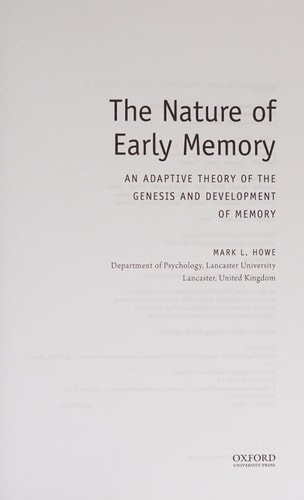
The Nature of Early Memory: An Adaptive Theory of the Genesis and Development of Memory
0
0
As an Amazon Associate and affiliate partner, Menrva Books earns from qualifying purchases. Learn more
Author Description
In this useful text, Mark L. Howe presents the most complete book-length exegesis of the research and theory concerning the emergence and development of declarative, long-term memory from birth through early adolescence. The book also contains the first presentation of Howe's theory that memory is an adaptive mechanism that is used to guide the development and survival of the organism in an initially novel, yet changing environment.The book is divided into four parts: In the first part, Howe discusses why memory development is important; in the second, he discusses infantile amnesia and autobiographical memory; in the third part, Howe explores a series of key factors that have an impact on early memory development--distinctiveness, emotion, stress, and maltreatment; and finally, he gives a detailed presentation of the theory of memory as an adaptation, and applies results to real-world problems.In addition to reviewing the basic-science research on both humans and nonhuman animals, Howe devotes a significant portion of the book to clinical and forensic topics, including the roles of stress and trauma in memory development, the development of false recollection, memory for traumatic experiences, the effects of depression, PTSD, and dissociation on early memory development, and nonhuman animal research on the nature of infantile amnesia. In bringing together this diverse-yet-influential body of literature, Howe presents a valuable resource for anyone interested in research on memory.
Menrva's Summary
THE THESIS
This book investigates the fundamental mechanisms governing the emergence and development of declarative, long-term memory from infancy through early adolescence. Mark L. Howe, a prominent researcher in developmental psychology, synthesizes decades of empirical data to propose a novel framework. He argues that memory functions primarily as an adaptive mechanism, evolved to facilitate survival and navigation within complex, changing environments. The text bridges basic-science research with clinical applications to explain how cognitive development is shaped by environmental and biological factors.
THE SCOPE MAP
What You Will Find
- A comprehensive review of infantile amnesia and the formation of autobiographical memory.
- Analysis of external variables including emotion, stress, and maltreatment on memory retention.
- Integration of human and nonhuman animal research to support evolutionary memory theories.
- Clinical and forensic applications regarding PTSD, depression, dissociation, and the formation of false recollections.
THE AUTHORITY PERSPECTIVE
Experts recognize this work as a foundational text for understanding the intersection of evolutionary biology and cognitive development. Readers frequently note the academic density of the prose, which serves as a rigorous resource for researchers and clinicians in the field of memory studies.
Page Count:
272
Publication Date:
2011-05-04
Publisher:
Oxford University Press
ISBN-10:
0195381416
ISBN-13:
9780195381412
Psychology
Developmental Psychology
Neuroscience
Memory
Community Tags
Similar Books