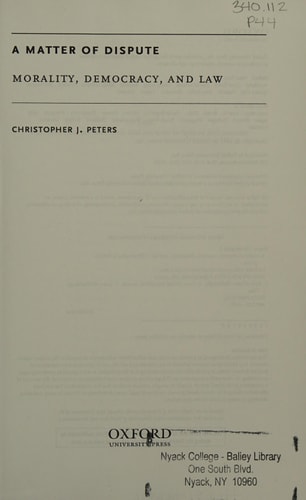
A Matter of Dispute: Morality, Democracy, and Law
0
0
As an Amazon Associate and affiliate partner, Menrva Books earns from qualifying purchases. Learn more
Author Description
Law often purports to require people, including government officials, to act in ways they think are morally wrong or harmful. What is it about law that can justify such a claim?In A Matter of Dispute: Morality, Democracy, and Law, Christopher J. Peters offers an answer to this question, one that illuminates the unique appeal of democratic government, the peculiar structure of adversary adjudication, and the contested legitimacy of constitutional judicial review. Peters contends that law should be viewed primarily as a device for avoiding or resolving disputes, a function that implies certain core properties of authoritative legal procedures. Those properties - competence and impartiality - give democracy its advantage over other forms of government. They also underwrite the adversary nature of common-law adjudication and the duties and constraints of democratic judges. And they ground a defense of constitutionalism and judicial review against persistent objections that those practices are "counter-majoritarian" and thus nondemocratic.This work canvasses fundamental problems within the diverse disciplines of legal philosophy, democratic theory, philosophy of adjudication, and public-law theory and suggests a unified approach to unraveling them. It also addresses practical questions of law and government in a way that should appeal to anyone interested in the complex and often troubled relationship among morality, democracy, and the rule of law.Written for specialists and non-specialists alike, A Matter of Dispute explains why each of us individually, and all of us collectively, have reason to obey the law - why democracy truly is a system of government under law.
Menrva's Summary
THE THESIS
This book investigates the fundamental question of why individuals and government officials are obligated to obey the law even when they perceive it as morally incorrect or harmful. Christopher J. Peters, a legal scholar, utilizes a framework centered on the functional role of law as a mechanism for dispute resolution. By analyzing the core properties of competence and impartiality, he argues that these elements provide the necessary justification for democratic governance, common-law adjudication, and the practice of judicial review.
THE SCOPE MAP
What You Will Find
- An analysis of the relationship between legal authority and individual moral judgment.
- A theoretical framework defining law as a device for dispute resolution.
- An examination of the democratic advantages of competence and impartiality in governance.
- A defense of constitutionalism and judicial review against counter-majoritarian critiques.
THE AUTHORITY PERSPECTIVE
Experts recognize this work as a bridge between abstract legal philosophy and practical public-law theory. Readers frequently note the accessibility of the prose, which manages to address complex jurisprudential questions for both specialists and non-specialists.
Page Count:
378
Publication Date:
2011-01-19
Publisher:
Oxford University Press
ISBN-10:
0195387228
ISBN-13:
9780195387223
Philosophy
Constitutional Law
Rule Of Law
Professional Career & Trade
Law
Jurisprudence
Democracy
Community Tags
Similar Books